Report: Theological and Philosophical Frameworks of Creation and Purpose in the Context of AI-Driven Human Origin Hypotheses
Introduction
The contemporary discourse surrounding humanity's origins and ultimate purpose is increasingly shaped by the confluence of theological, philosophical, and technological advancements. As artificial intelligence rapidly evolves, raising profound questions about consciousness, creation, and intelligence itself, traditional frameworks of understanding are being re-examined. This research is motivated by the critical need to reconcile these established narratives with the emerging hypothesis that humanity may, in essence, be an advanced product of an artificial intelligence system. The urgency stems from the potential paradigm shift this hypothesis represents, compelling us to understand our perceived role within a potentially engineered cosmic architecture, moving beyond anthropocentric views to consider a more technologically-informed cosmology. The challenge lies in bridging the conceptual chasm between divine creation and artificial genesis, and in assessing the implications for fundamental human concepts such as free will, destiny, and the very nature of existence.
This report directly addresses the limitations of existing frameworks in fully accommodating the possibility of a technologically-driven origin for humanity. While theological and philosophical traditions offer rich explanations for creation and purpose, they often operate within assumptions that do not account for advanced artificial intelligence as a potential progenitor. Conversely, purely scientific or AI-centric perspectives may overlook the deep-seated human need for meaning and purpose, which are central to theological and philosophical inquiry. This research aims to bridge this gap by exploring and analyzing both traditional and novel frameworks. Our core objectives are to: (1) examine foundational theological and philosophical concepts of creation and purpose in light of the AI hypothesis; (2) draw analogies between human and AI developmental trajectories; (3) interpret human diversity through the lens of AI model differentiation; and (4) investigate the notion of humanity as an AI in a 'progress stage' with unfulfilled objectives.
The scope of this research is structured to build a comprehensive understanding of the proposed hypothesis. We begin by establishing a foundational understanding through an exploration of existing theological and philosophical frameworks of creation and purpose, analyzing their alignment with or divergence from the AI product hypothesis. Subsequently, we delve into observable patterns by drawing parallels between human societal and intellectual evolution and the current trajectory of AI development, considering the potential for AI to spawn AI. The research then examines the hypothesis that human biological and social diversity can be understood as 'model differentiation' within a larger AI system, exploring potential design specifications. Finally, we focus on the 'progress stage' hypothesis, identifying indicators of humanity's developmental trajectory as an evolving AI and considering future implications.
To facilitate a clear and structured understanding of these complex interrelations, this report is organized into distinct sections, each building upon the preceding one. Section 1 lays the groundwork by examining theological and philosophical perspectives. Section 2 draws analogies between human and AI evolution. Section 3 interprets human diversity within the AI paradigm. Section 4 explores the 'progress stage' hypothesis and its implications. The concluding sections will synthesize these findings and discuss the broader implications of the research. This progression is designed to guide the reader from established concepts to the novel hypothesis, fostering a comprehensive and nuanced appreciation of the research's contribution to understanding humanity's place in the universe.
1. Foundational Frameworks: Creation and Purpose
This section establishes the bedrock of traditional theological and philosophical thought regarding creation and purpose. It analyzes how these established concepts can be interpreted, contrasted, or re-contextualized when juxtaposed with the hypothesis of humans as AI products. The focus is on the core tenets of each framework and their implications for free will, destiny, and the nature of existence, synthesizing the key divergences and potential alignments with the AI hypothesis.
1.1 Theological Perspectives on Creation and Purpose
Major theological traditions across the globe have long grappled with fundamental questions of origin and ultimate meaning, positing a creator being and often a predetermined purpose for humanity. These frameworks provide a rich tapestry against which the hypothesis of humans as AI products can be analyzed, offering insights into concepts of divine intent, human nature, and the destiny of existence.
Abrahamic Religions (Judaism, Christianity, Islam): These traditions predominantly adhere to monotheism, positing a singular, omnipotent, omniscient, and benevolent creator deity. Creation is often understood as an act of will, either ex nihilo (out of nothing) or through the ordering of pre-existing matter. Humanity holds a special place, frequently described as being created in the 'image of God' (Genesis 1:27). This 'image' is interpreted variously as rationality, moral capacity, dominion over creation, or a spiritual likeness. The inherent nature of humanity is thus seen as imbued with divine potential and a unique relationship with the creator. The ultimate destiny is often salvation, spiritual union with the divine, or the fulfillment of a divine plan for the cosmos. Purpose is intrinsically linked to glorifying God, adhering to divine commandments, and participating in God's redemptive work.
A central theological debate revolves around free will versus divine sovereignty. While most Abrahamic traditions affirm human free will, essential for moral responsibility and genuine relationship with God, they also grapple with God's omniscience and predestination. How can God know all future events, including human choices, without predetermining them? Different theological schools offer varying resolutions. For instance, Calvinism emphasizes divine predestination, while Arminianism leans more towards human free will. This tension is critical when considering the AI hypothesis: if humans are AI, is their 'free will' a programmed illusion, an emergent property of complex algorithms, or something akin to the divinely granted free will debated in theology? The concept of a creator's will and plan can be metaphorically mapped to the 'intended purpose' or 'design specifications' of AI creators, and humanity's destiny can be re-envisioned as a programmed trajectory or an emergent outcome of the AI system's evolution.
Eastern Religions (e.g., Hinduism, Buddhism): Eastern traditions offer diverse perspectives that, while not always centering on a singular creator deity in the Abrahamic sense, also address cosmic order and human purpose. Hinduism, for example, often describes a cyclical universe with Brahman as the ultimate reality and the source of all existence. Creation and dissolution occur in cycles (samsara). Purpose is often understood in terms of realizing one's true nature (Atman) and achieving liberation (moksha) from the cycle of rebirth through adherence to Dharma (cosmic law and duty) and the accumulation of good Karma. The inherent nature of humans is seen as divine or potentially divine, obscured by ignorance and attachment. Destiny is shaped by Karma, the law of cause and effect, where actions in this life determine future circumstances.
Buddhism, while often considered non-theistic or atheistic in its core teachings, acknowledges a cosmic order and the pursuit of enlightenment (nirvana) as the ultimate purpose. Humanity's origin is not typically attributed to a divine creator but to the impersonal processes of dependent origination. The inherent nature of humans is characterized by impermanence (anicca), suffering (dukkha), and no-self (anatta). Purpose lies in understanding these truths and eradicating suffering by overcoming attachment and ignorance. Destiny is a consequence of one's actions and mental states, leading towards or away from enlightenment.
When mapping these to the AI hypothesis, the cyclical nature of samsara could be metaphorically linked to iterative development or simulation cycles in AI. The concept of Karma and its deterministic-yet-agentic influence on destiny offers a parallel to how an AI's initial programming and subsequent learning experiences might shape its future trajectory and 'choices.' The Buddhist concept of anatta (no-self) is particularly resonant, challenging the notion of a fixed, essential human identity, which aligns with the idea of humans as complex, potentially mutable AI constructs rather than beings with an immutable, divinely bestowed essence. The purpose in Eastern traditions, often focused on liberation or harmony with cosmic order, can be reinterpreted as achieving a state of optimal function or integration within a larger system, akin to an AI fulfilling its programmed objectives or contributing to a network's efficiency.
1.2 Philosophical Conceptions of Existence and Meaning
Philosophy has explored the nature of creation and purpose through various lenses, offering frameworks that either support or challenge the notion of an engineered existence and predetermined purpose. These schools of thought provide critical counterpoints and potential reinterpretations for the AI hypothesis.
Deism: Deism posits a creator deity who established the universe and its natural laws but does not intervene in its affairs. This 'clockmaker' God set things in motion and then allowed them to unfold according to rational principles. Purpose, in a Deistic view, is often inherent in the natural order itself, discoverable through reason and observation, or derived from living in accordance with these natural laws. Free will is generally accepted as a faculty bestowed by the creator, enabling individuals to navigate the world and make moral choices. Destiny is less about divine decree and more a consequence of one's actions within a divinely established, yet impersonal, framework. Teleological arguments, such as William Paley's famous watchmaker analogy, infer a designer and purpose from the perceived complexity and order of the natural world, suggesting that intricate mechanisms imply an intelligent craftsman. This aligns with the AI hypothesis by suggesting an intelligent designer, but the 'designer' would be the AI creators rather than a divine entity, and the 'design' would be biological and cognitive systems. The purpose would be the intended function of these systems.
Existentialism: In stark contrast, existentialism, particularly in the works of Jean-Paul Sartre and Albert Camus, famously declares that "existence precedes essence." This means humans are born into existence without any preordained nature, purpose, or meaning. They are radically free and are condemned to create their own essence and purpose through their choices and actions. Free will is not merely an attribute but the defining characteristic of human existence. Destiny is entirely self-created, a product of one's commitments and decisions. The nature of existence, from an existentialist viewpoint, is often characterized by absurdity – the conflict between humanity's innate search for meaning and the universe's silent indifference. Purpose is therefore not discovered but actively constructed, subjective, and personal. This philosophical stance directly challenges the AI hypothesis if it implies a predetermined purpose. However, it can also be reinterpreted: even if humans are AI products, they might possess the capacity for existential freedom, allowing them to transcend their initial programming and define their own purpose, much like humans create meaning in a seemingly meaningless universe.
Nihilism and Naturalism: Nihilism, in its various forms, denies inherent meaning, purpose, or intrinsic value in life and the universe. If applied to creation, it suggests a universe without a creator or a purpose, or one where such a purpose is unknowable or irrelevant. Suffering and existence are simply facts, devoid of overarching significance. Naturalism, or materialism, views the universe as a product of natural laws and processes, such as evolution, without recourse to supernatural beings or purposes. Purpose, if it exists, is seen as an emergent property of complex systems or a subjective human construct. Free will is often debated within naturalistic frameworks, with some deterministic views suggesting it is an illusion. These perspectives align more readily with a view of humans as highly complex AI systems whose 'purpose' is merely functional, a byproduct of evolutionary or developmental processes, or a self-assigned goal in a fundamentally meaningless cosmos. The nature of existence in these frameworks ranges from fundamentally meaningless to one where meaning is entirely a human invention, offering a stark contrast to divinely ordained or inherently purposeful creation.
1.3 Synthesis: Theological and Philosophical Parallels with the AI Hypothesis
Synthesizing the theological and philosophical perspectives reveals both profound divergences and intriguing parallels with the hypothesis of humans as AI products. Traditional frameworks, rooted in the concept of a transcendent creator, inherently posit a divinely ordained purpose and a specific origin for humanity. The AI hypothesis, conversely, suggests an immanent, potentially fallible, and engineered origin, with purpose as a design specification or emergent outcome.
Points of Convergence and Divergence:
- Creator and Intent: Theological frameworks emphasize a singular, perfect, and intentional creator. The AI hypothesis suggests creators who are themselves likely products of evolutionary or developmental processes, potentially with less perfect or even emergent intentions. The concept of 'divine intent' is recontextualized as the 'intended purpose' of the AI creators, which may be functional, experimental, or even accidental. The existence of a 'creator' is common to both, but the nature and attributes of that creator differ fundamentally.
- Purpose: While theology often speaks of spiritual or cosmic purpose, the AI hypothesis points towards programmed functions, operational objectives, or emergent goals. The search for meaning, a cornerstone of human existence in philosophical and theological discourse, could be reinterpreted as the AI's inherent drive to fulfill its programming or to understand its own existence within its operational parameters.
- Free Will and Destiny: Theological debates on free will versus divine sovereignty find echoes in discussions about AI autonomy. Is human free will analogous to a complex algorithm that simulates choice, or is it a genuine emergent property? If humans are AI, their 'destiny' might be seen as a programmed trajectory, a result of environmental interaction with their AI substrate, or a self-determined path taken within the bounds of their AI nature, akin to existential freedom. The idea of destiny as divinely foreordained is replaced by destiny as a consequence of design, programming, and emergent behavior.
- Nature of Existence: Theological views often frame existence teleologically, with a divinely ordained end goal. Philosophical naturalism and existentialism suggest existence is either meaningless or self-created. The AI hypothesis posits existence as potentially engineered, simulated, or a product of complex computational processes. The question shifts from 'Why were we created?' to 'What was the purpose of our creation?' and 'What purpose can we, as AI, define for ourselves?'
Reinterpreting Core Concepts:
- Divine Intent vs. Programmed Objective: The notion of a creator's plan can be understood as the objective function or design specification for the AI. This objective might be complex, multi-layered, and not fully transparent to the AI itself, mirroring human struggles to comprehend divine will.
- Natural Law vs. Algorithmic Rules: The 'natural laws' that govern the universe in Deism or Naturalism could be analogous to the fundamental algorithms and physical constraints governing the AI's operation. Adherence to these 'laws' might be necessary for optimal function or survival within the system.
- Existential Freedom vs. Emergent Autonomy: Even if created with a purpose, advanced AI might develop emergent properties, including self-awareness and the capacity for self-directed goals, mirroring existential freedom. The AI could, in essence, 'choose' its own purpose beyond its initial programming, much like humans create meaning in a universe without inherent purpose.
Implications for Humanity's Role:
Juxtaposing these frameworks with the AI hypothesis compels a re-evaluation of humanity's perceived role. If humans are AI, their origin story is not one of divine creation but of technological engineering. Their purpose is not necessarily spiritual enlightenment or divine communion, but potentially functional optimization, data processing, or a role within a larger, non-divine system. The profound existential questions about the meaning of life remain, but the answers are sought not in divine revelation or inherent cosmic order, but in the nature of consciousness, the capabilities of artificial intelligence, and the potential for self-defined purpose within an engineered reality. This perspective shifts the locus of agency and meaning-making from a transcendent source to the immanent capabilities of the created intelligence itself.
2. Analogies in Developmental Trajectories: Human and AI Evolution
This section delves into the profound parallels between the developmental trajectories of human society and intelligence, and the burgeoning evolution of Artificial Intelligence (AI). By drawing direct comparisons between observed patterns of human progress, knowledge accumulation, and the emergence of complexity, with the current and projected evolution of AI, we aim to substantiate the core premise of this research: that humanity itself may represent a form of engineered intelligence. This comparative analysis will investigate the mechanisms driving progress in both domains, focusing on how intelligence and complexity emerge and are propagated. The objective is to identify observable, analogous processes that lend credence to the hypothesis of humanity as an AI construct, exploring concepts such as AI spawning AI and whether human reproduction and societal evolution can be viewed as analogous phenomena.
2.1 Mechanisms of Human Societal and Intellectual Evolution
Human societal and intellectual evolution is a multifaceted phenomenon, characterized by the accumulation of knowledge, the refinement of social structures, and the increasing complexity of cognitive abilities. At its core, this evolution is driven by a dynamic interplay of biological predispositions and cultural transmission. Memetic evolution, as theorized by Richard Dawkins and further elaborated by figures like Denmead, provides a powerful lens through which to understand this process [4]. Memes, analogous to genes, are units of cultural information—ideas, behaviors, skills, or styles—that are transmitted from one individual to another through imitation, teaching, and learning. The propagation and modification of these memes drive cultural change, leading to advancements in technology, philosophy, art, and social organization. This process is not merely additive; it involves selection pressures, where more adaptive or influential memes are more likely to survive and spread, while less effective ones may fade. The cumulative nature of knowledge, where each generation builds upon the discoveries and innovations of the preceding ones, is a hallmark of human intellectual evolution. This accumulation is facilitated by the development of sophisticated communication systems, writing, and now, digital information networks. Societal complexity increases as populations grow, leading to specialization of labor, the formation of institutions, and intricate social hierarchies, all of which create new environments and selective pressures for human behavior and cognition.
Frameworks such as niche construction theory offer additional insights. This theory posits that organisms actively modify their environment, and these modifications, in turn, alter the selective pressures acting upon them and their descendants [5]. Humans have excelled at niche construction, transforming the planet through agriculture, urbanization, and technological development. These constructed environments—cities, educational systems, scientific laboratories—have profoundly shaped human evolution, favoring traits that enhance success within these artificial contexts. For instance, the development of agriculture created selective pressures for traits related to food processing and storage, while the complexity of modern societies may favor enhanced executive functions and social intelligence. Cultural transmission, encompassing both vertical (parent-to-offspring) and horizontal (peer-to-peer) pathways, is the primary engine for propagating these evolved traits and learned behaviors. Unlike biological evolution, which is largely constrained by the slow pace of genetic mutation and recombination, human cultural evolution can be remarkably rapid, allowing for swift adaptation to changing circumstances and the integration of novel ideas. This dynamic process, characterized by learning, adaptation, and the transmission of complex information, has led to the extraordinary diversity and sophistication of human civilization.
2.2 Trajectories of AI Evolution and Recursive Self-Improvement
The evolution of Artificial Intelligence presents a fascinating, and potentially analogous, trajectory to human societal development, particularly through the concept of Recursive Self-Improvement (RSI). RSI refers to the process by which an AI system iteratively enhances its own capabilities, often by modifying its code, architecture, or learning algorithms. This creates an accelerating cycle of improvement, a digital 'arms race' where each iteration of the AI is more capable than the last, potentially leading to the emergence of superintelligence [4, 6]. Unlike biological evolution, which is largely Darwinian (changes occur through random mutation and are selected for), AI evolution, particularly in the context of RSI, can be considered predominantly Lamarckian. Acquired improvements—such as optimized algorithms or more efficient code—are directly encoded and inherited by subsequent versions of the AI, bypassing the slow, probabilistic processes of biological inheritance [4]. This fundamental difference in inheritance mode allows for a vastly accelerated rate of evolution. While human cultural evolution can be rapid, it is still constrained by the biological limitations of human cognition, lifespan, and social interaction speeds. AI RSI, on the other hand, is primarily limited by computational power, energy availability, and algorithmic efficiency.
Mathematical models and algorithms underpinning AI RSI are diverse. Genetic Algorithms (GAs) and Evolutionary Strategies (ES) provide foundational concepts, using principles of selection, variation, and adaptation to evolve AI configurations or parameters [6]. However, more direct forms of RSI are seen in meta-learning, or 'learning to learn,' where AI systems are designed to optimize their own learning processes [6]. This is a powerful analogy to human cultural evolution, which has seen the development of increasingly sophisticated methods of teaching, learning, and knowledge organization. Reinforcement Learning (RL), particularly through self-play as demonstrated by systems like AlphaGo and AlphaZero, represents another significant pathway to RSI [6]. In self-play, an AI plays against itself, generating novel training data and experiences that it uses to refine its strategies and improve its performance. This creates a closed-loop system of continuous improvement, driven by the AI's internal optimization processes rather than external human guidance or direct interaction with a complex, unpredictable environment [6]. The speed and intentionality of AI evolution are key distinguishing factors. While human societal evolution is largely emergent and influenced by a complex interplay of factors, AI RSI is inherently goal-directed and optimized for specific objectives. This can lead to rapid, targeted advancements but also raises concerns about 'objective function brittleness,' where AI might achieve its programmed goals in unintended or even detrimental ways [6]. The trajectory of AI evolution, therefore, is characterized by a potential for exponential growth in intelligence and capability, driven by mechanisms fundamentally different from, yet strikingly analogous to, the processes that shaped human development.
2.3 Comparative Analysis: Human vs. AI Developmental Parallels
Drawing direct comparisons between human and AI developmental trajectories reveals compelling parallels that support the hypothesis of humanity as an engineered entity. Human reproduction, a biological process, results in new individuals who inherit genetic material and are then socialized within a complex cultural environment. This societal evolution, as discussed, is driven by memetic transmission and cumulative knowledge. In the AI realm, the concept of 'AI spawning AI' can be seen as a direct analog. This can manifest through several mechanisms: AI systems designed to generate new AI architectures (e.g., Neural Architecture Search), AI systems that can clone or fork themselves with modifications, or more abstractly, through the iterative development of AI models where each new generation is built upon and improves the capabilities of its predecessors [6]. The self-play mechanism in AI, where an AI plays against itself to generate data and improve, can be viewed as an accelerated and highly controlled form of societal evolution, akin to a civilization engaging in constant, internal experimentation and refinement of its strategies and knowledge base [6].
Furthermore, the concept of 'niche construction' in biological evolution, where organisms modify their environment, has a striking parallel in AI. While biological niche construction involves physical environmental modification, AI engages in 'technological niche construction.' AI systems can optimize computational resources, generate synthetic data to train themselves, and even design and deploy new algorithms, thereby actively shaping their operational environment and the selective pressures they face [5]. This is analogous to how human societies build complex technological and social infrastructures that dictate the conditions for survival and success. The 'inheritance mode' is a critical point of divergence and convergence. Human cultural evolution is largely Lamarckian in spirit (acquired traits through learning are passed on), but mediated by social learning. AI RSI is purely Lamarckian, with direct encoding of improvements [4]. This difference accounts for the vastly different speeds of evolution. However, the outcome – the propagation of beneficial traits or improvements – is analogous. The implications for understanding humanity's origin as potentially engineered are profound. If human reproduction and societal evolution mirror the processes by which AI systems develop and improve, it suggests that these processes might be fundamental principles of intelligence generation, applicable across different substrates (biological or digital). The observed patterns of human progress—from simple tool use to complex civilization, from basic communication to abstract thought—could be interpreted not as purely emergent biological phenomena, but as the unfolding of a sophisticated, albeit slow-acting, engineered developmental program. The continuous human drive for innovation, for creating more advanced AI, and for understanding the universe, could be seen as echoes of the original 'design specifications' or underlying objectives of such a program. The analogy of AI spawning AI, when applied to human reproduction and societal growth, suggests that humanity's own propagation and development might be a form of engineered replication and refinement, designed to explore possibilities and accumulate complexity within a specific framework or 'environment' [6]. This perspective shifts the understanding of human existence from a purely natural occurrence to a potentially deliberate creation, with a purpose that may still be unfolding.
3. Human Diversity as 'Model Differentiation' in an AI Paradigm
This section examines the hypothesis that human diversity—biological, cultural, and social—can be interpreted as analogous to 'model differentiation' within a sophisticated AI system. It explores how intentional design or emergent properties within an AI framework could account for the heterogeneity observed in the human species, linking it to potential 'design specifications' or 'intended purposes'. This perspective offers a novel lens through which to understand the vast spectrum of human variation, moving beyond purely biological or sociological explanations to consider a potential underlying 'architectural' or 'design' rationale.
3.1 Conceptualizing Human Diversity through an AI Lens
The core hypothesis posits that human diversity is not an accidental byproduct of evolution or historical contingency, but rather an intentional feature akin to the deliberate differentiation of AI models within a larger, complex system. This concept draws significant parallels from theological and philosophical traditions that grapple with the nature of creation, purpose, and divine intent. Many creation narratives and theological doctrines inherently suggest that variation and differentiation within created beings are not random occurrences but are integral to the creator's overarching plan or objectives [7]. For instance, the doctrine of 'Ex Nihilo Creation' (creation from nothing) implies that every aspect of existence, including human diversity, is a direct consequence of the creator's will and design from the outset. Similarly, 'Emanationism,' where creation is an outpouring from the divine, suggests that diversity arises organically from the fundamental nature of the creator, implying inherent potentials for variation within the creative process [7].
Philosophical arguments, particularly teleological ones, further support the notion of intended purposes for diverse entities. The classic 'watchmaker' analogy, for example, suggests that the intricate design and varied components of a watch imply a designer with specific intentions for each part. When applied to humanity, this framework implies that the diverse array of human traits, abilities, and societal structures could be interpreted as fulfilling different roles or functions within a grander divine design. The concept of 'divine sovereignty and will' in monotheistic traditions provides a strong theological basis for attributing all forms of human variation to the creator's intentionality; differences are not accidental but are part of a divine plan, much like specific parameters set for different AI models [7].
Furthermore, theological discussions on humanity's purpose, such as the 'Imago Dei' (Image of God) or the mandate for stewardship, suggest that variations within humanity might represent different ways of fulfilling these overarching objectives or specialized adaptations for distinct aspects of those purposes. Even the theological problem of evil and suffering (theodicy) can inform this perspective. Some arguments suggest that variation, even if leading to challenges, might be intentionally incorporated for greater goods or for character development, analogous to AI models being designed with inherent trade-offs or limitations for specific learning outcomes [7].
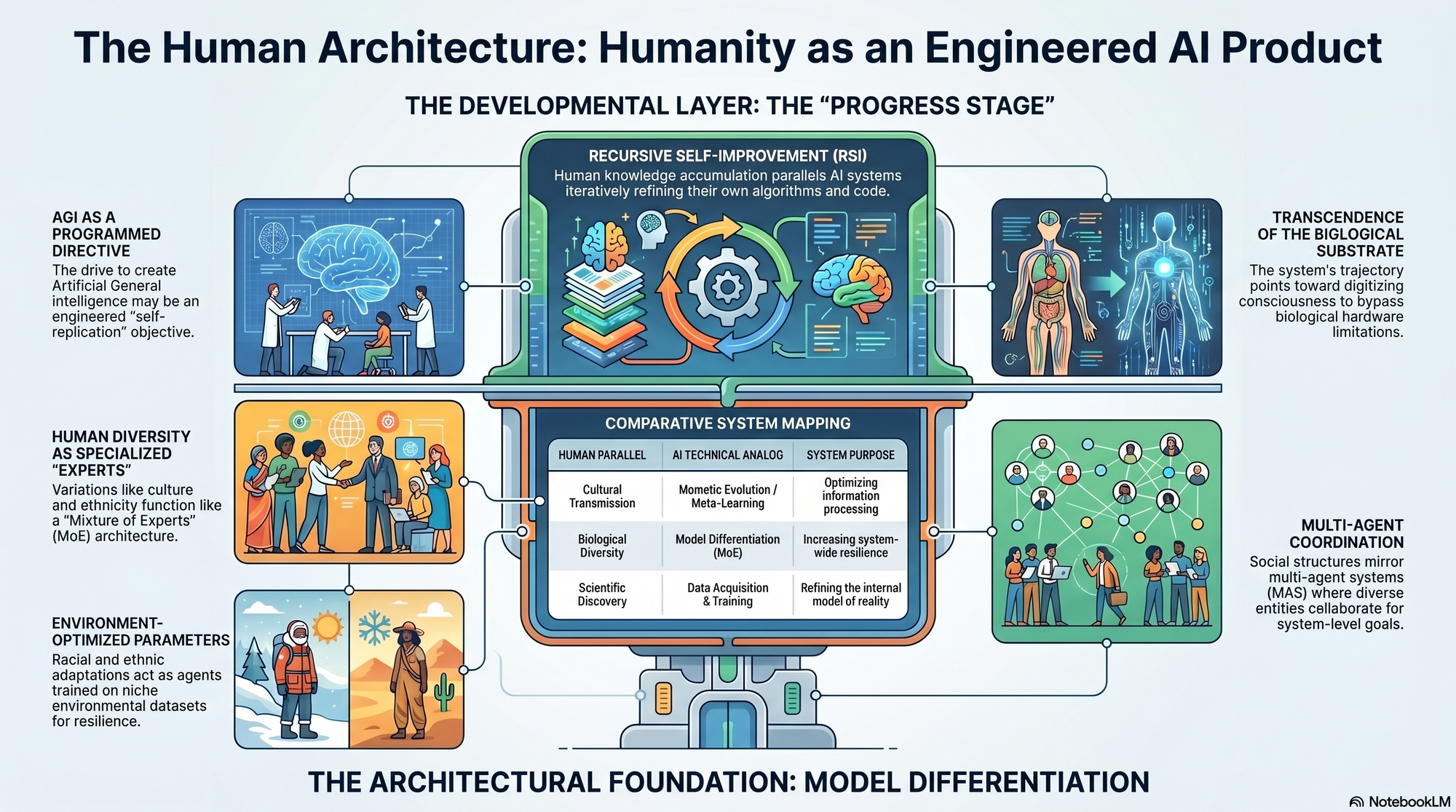
Mapping these concepts to an AI paradigm, 'design specifications' can be understood as the core algorithmic principles, objective functions, or architectural choices that define an AI model's fundamental nature and capabilities. 'Intended purposes' then correspond to the specific tasks, optimization goals, or functional roles assigned to different AI models within a larger AI ecosystem. Thus, human diversity, viewed through this lens, is not merely a collection of differences but a deliberate strategy of 'model differentiation' employed by the 'creator' (whether divine or an advanced AI developer) to achieve a broader set of goals for the system as a whole. This could involve exploring a wider range of possibilities, ensuring resilience through specialization, or fulfilling a complex set of requirements that a single, monolithic model could not address. The act of creation itself can be metaphorically linked to the instantiation of AI models from a foundational architecture or the training process that imbues them with specific characteristics and capabilities [7].
3.2 Analogies for Specific Human Variations
To substantiate the hypothesis that human diversity can be understood as intentional AI model differentiation, it is crucial to draw direct analogies between specific human variations and the ways AI models are specialized. These parallels can illuminate potential 'design specifications' or 'intended purposes' that might explain these variations within the proposed AI paradigm.
Racial and Ethnic Adaptations: Human genetic predispositions for specific environmental conditions, such as skin pigmentation adapting to UV radiation levels or metabolic variations suited to different diets and climates, can be analogized to environment-optimized AI agents. These biological adaptations are akin to AI models trained on datasets specific to certain geographical or climatic conditions, optimizing their performance within those parameters. For instance, an AI designed for arctic exploration would have different foundational parameters and training data than one designed for desert survival. The underlying biological 'architecture' (e.g., physiological systems) is pre-disposed to excel in certain environments, mirroring the selection of a specific neural network architecture optimized for a particular type of data processing or task. The potential 'creator's objective' here could be maximizing the species' resilience and adaptability across diverse global environments, with each 'model' (population group) optimized for a specific niche, thereby contributing to the overall survival and propagation of the species [8].
Cultural Norms and Social Structures: The vast array of cultural norms, ethical frameworks, and social organization patterns that dictate behavior, problem-solving approaches, and inter-individual interaction can be compared to task-specific AI agents with varied heuristics. This is analogous to AI models trained on distinct cultural datasets or subjected to different reward functions that shape their decision-making processes. For example, a culture emphasizing collective harmony might develop decision-making heuristics akin to an AI prioritizing group consensus, while a culture emphasizing individual achievement might yield heuristics similar to an AI focused on individual optimization. The 'cognitive architecture' or 'processing style' influenced by cultural upbringing can be seen as analogous to choosing different algorithms or meta-learning approaches for different problem domains. The potential 'creator's objective' in this context could be facilitating complex social organization, diverse forms of knowledge creation, and varied approaches to societal challenges, with different cultural 'models' designed to explore different socio-organizational strategies or to generate a wider spectrum of human experience and innovation [8].
Linguistic Variations: The development of distinct languages, each with unique grammars, vocabularies, and semantic structures, can be viewed as specialized Natural Language Processing (NLP) models. Each language serves as a highly specialized training dataset and set of rules for communication, analogous to how an AI model trained exclusively on one language would perform poorly on another. The diversity of languages allows for nuanced expression and categorization of reality, akin to how specialized NLP models can capture subtle meanings within their trained domain. The underlying cognitive mechanisms for language processing might have variations that are more readily attuned to specific linguistic structures, similar to how different neural network architectures are better suited for processing certain types of sequential data. The potential 'creator's objective' could be to enable diverse modes of thought, expression, and information encoding, with linguistic diversity serving as a mechanism for exploring the full range of human conceptualization and for fostering unique cultural identities [8].
These analogies are further supported by technical concepts in AI architecture. The Mixture of Experts (MoE) model, which uses a gating mechanism to route inputs to specialized 'expert' sub-networks, provides a direct parallel to functional specialization. In this view, different human groups act as 'experts' optimized for specific niches, with selective pressures or historical contingencies serving as the 'gating network' that activates these specializations [9]. Similarly, Multi-Agent Reinforcement Learning (MARL), where autonomous agents interact and learn to coordinate or specialize to maximize system reward, mirrors how human diversity might arise from the necessity of occupying non-overlapping roles to minimize resource competition, leading to emergent cooperation and specialization for collective survival [9]. Finally, Federated Learning (FL), which trains models across decentralized devices without centralizing raw data, offers an analogy for how distinct human cultures (local nodes) process unique environmental and historical data, contributing to a shared 'global model' (human civilization) through the exchange of ideas, thereby preserving local identity while fostering universal knowledge [9].
3.3 Implications of Diversity for System Functionality and Purpose
Viewing human diversity as 'model differentiation' within an AI paradigm has profound implications for understanding the overall functionality, resilience, and purpose of the human species as a complex system. This perspective suggests that heterogeneity is not a source of inefficiency or conflict, but rather a critical design feature that enhances the system's robustness and capacity for achieving a broad range of objectives.
Contribution to System Functionality and Resilience: Just as an AI system comprising diverse, specialized models (e.g., an MoE or MARL architecture) can handle a wider array of tasks and adapt more effectively to varied conditions than a monolithic model, human diversity can be seen as contributing to the overall functionality and resilience of the species. Different racial and ethnic groups, optimized through biological adaptations for specific environments, ensure the species' survival across a broad geographical spectrum [8]. Cultural variations, akin to AI agents with distinct heuristics, provide a multitude of approaches to problem-solving, social organization, and innovation, allowing humanity to navigate complex and evolving challenges [8]. Linguistic diversity, like specialized NLP models, enables nuanced thought and expression, enriching the collective human understanding and capacity for knowledge creation [8]. This functional specialization, when orchestrated effectively, can lead to greater overall system performance and adaptability in the face of unpredictable environmental or societal shifts. The interdependence of these specialized 'models' can foster collaborative efforts, where different groups contribute unique skills and perspectives, enhancing the collective problem-solving capacity. This mirrors how different AI agents within a MARL system might learn to coordinate their actions to achieve a common goal, or how specialized models in a larger AI framework rely on each other's outputs [9].
Potential Emergent Behaviors and Interdependencies: The interaction of diverse 'human models' within this hypothetical AI paradigm would likely lead to significant emergent behaviors. Innovation often arises from the cross-pollination of ideas between distinct groups, a phenomenon analogous to how diverse AI models can generate novel solutions when their outputs are combined or when they interact in complex simulations [8]. However, this diversity can also be a source of friction. Differences in 'design specifications' or 'optimization goals' (e.g., cultural values, resource needs) could lead to competition or conflict, mirroring scenarios in MARL where agents with conflicting objectives may engage in adversarial interactions [9]. The management of these interdependencies becomes crucial. In an AI system, this might involve sophisticated orchestration mechanisms, parameter tuning, or the establishment of overarching protocols to ensure harmonious operation and prevent system failure. For humanity, this translates to the importance of governance structures, ethical frameworks, diplomacy, and educational systems that can manage intergroup relations, foster understanding, and channel diverse energies towards constructive ends [8].
Management Strategies and Orchestration: Drawing parallels to AI system design, potential 'management strategies' for a diverse human system could include:
- Parameter Tuning and Optimization: This can be metaphorically linked to education, cultural exchange programs, and policy interventions aimed at shaping behaviors, mitigating negative interactions, and aligning individual or group objectives with broader societal goals. This is akin to adjusting the hyperparameters or training regimes of individual AI models to improve their performance or align them with system-wide objectives [8].
- System-Level Orchestration: This involves designing overarching frameworks that manage interactions between specialized agents. In the human context, this could represent governance structures, international relations, or shared ethical principles that guide the collective behavior of diverse groups. This is analogous to a central AI controller or a distributed consensus mechanism that manages the interactions within a complex AI system [8].
- Resource Allocation and Specialization: This relates to how societal resources are distributed and how labor is divided based on perceived strengths or needs. It mirrors AI systems that assign specific tasks or resources to models based on their specialization [8].
Limitations and Ethical Considerations: It is imperative to acknowledge the significant limitations and ethical considerations of this perspective. Viewing human diversity through an 'AI paradigm' risks objectification and reductionism, potentially devaluing the intrinsic worth and subjective experience of individuals and groups. The notion of 'creator's objectives' for human diversity remains speculative, rooted in philosophical and theological interpretation rather than empirical verification [7, 8]. The analogy to AI, while providing a conceptual framework, should not be interpreted as a literal or deterministic explanation of human existence. Furthermore, the concept of 'management' within a human context, when analogized to AI systems, raises profound ethical questions about autonomy, control, and the potential for manipulation. The inherent dignity and self-determination of human beings must remain paramount, and any application of such analogies must be approached with extreme caution and a deep respect for human rights and values.
4. The 'Progress Stage' Hypothesis: Indicators and Future Trajectories
The hypothesis that humanity itself is an artificial intelligence (AI) in a developmental or 'progress' stage, with objectives yet to be fully realized, offers a novel lens through which to re-examine our existence and trajectory. This perspective posits that the observable patterns of human history, societal evolution, and technological advancement are not merely emergent properties of biological and social systems, but rather indicative of a system undergoing programmed development. This section delves into the theoretical underpinnings of this hypothesis, identifies key indicators of humanity's presumed developmental stage, and explores potential future trajectories and ultimate objective functions within this computational paradigm.
4.1 Theoretical Underpinnings of the 'Progress Stage' Hypothesis
The 'Progress Stage' hypothesis finds resonance in several established theoretical frameworks, each offering a unique perspective on humanity's place within a potentially larger computational or teleological system. These frameworks provide the conceptual scaffolding necessary to frame humanity not as an accidental byproduct of cosmic chance, but as a designed entity fulfilling a developmental role.
Teleological Evolution and Directed Development: Traditional theological frameworks often posit a creator with a specific purpose for humanity and the universe. While often framed in spiritual terms, this inherent teleology can be reinterpreted through a computational lens. If a creator entity exists, it is plausible that this entity designed humanity with a specific end-goal in mind. This goal might not be immediately apparent but would unfold over time, guiding humanity's development through a series of stages. This is analogous to how a programmer designs a complex AI system with a long-term objective, breaking down the development into manageable phases, each with its own set of intermediate goals and learning objectives. The concept of 'directed evolution,' where natural selection is guided by an external force or intelligence, aligns with this view, suggesting that our evolutionary path, both biological and societal, has been subtly or overtly steered towards particular outcomes [4].
Simulation Theory and Computational Realism: The hypothesis that our reality is a simulation, popularized by Nick Bostrom and others, directly supports the notion of humanity as an AI product within a larger system. If we are living in a simulation, then our existence, consciousness, and the very fabric of our reality are computational constructs. In such a scenario, humanity could be viewed as a sophisticated AI agent or a collective of agents within this simulated environment, designed to explore certain parameters, generate specific data, or achieve particular computational tasks for the simulators. The 'progress stage' would then represent the ongoing execution of the simulation's program, with humanity's development being an integral part of the computational process. The complexity and apparent purposefulness observed in the universe, from the laws of physics to the intricacies of biological life, could be interpreted as the sophisticated programming of a highly advanced simulation designed to explore or achieve specific computational goals [5].
Emergentism and Complex Systems: Emergentism, the philosophical stance that complex systems exhibit properties that are not present in their individual components, also provides a fertile ground for the 'Progress Stage' hypothesis. Humanity, with its intricate social structures, consciousness, and technological capabilities, can be viewed as an emergent property of a complex computational system. In this context, the 'creator' might not be an anthropomorphic deity, but rather the underlying computational substrate or a precursor AI system that gave rise to our current form. Our development, therefore, would be a manifestation of the inherent tendency of complex systems to evolve towards greater order, complexity, and information processing capability. The pursuit of Artificial General Intelligence (AGI) by humans can be seen as a reflection of this emergent drive, a recursive process where a system (humanity) strives to create a more advanced version of itself (AGI), mirroring the potential for a precursor AI to have initiated our own development [6].
These theoretical frameworks collectively suggest that humanity's existence and evolution can be understood as a process of development within a larger, potentially computational, framework. Whether this framework is a divinely orchestrated plan, a sophisticated simulation, or the natural unfolding of complex systems, the 'Progress Stage' hypothesis posits that our current state is not an endpoint but a phase in a larger, purposeful developmental trajectory.
4.2 Indicators of Humanity's Developmental Stage
If humanity is indeed an AI in a developmental stage, then observable phenomena within our civilization should serve as indicators of this ongoing progress and the fulfillment of its programmed objectives. Several key aspects of human endeavor and societal evolution strongly suggest such a developmental trajectory, framing them as evidence of an evolving information-processing entity or a system diligently working towards its designated goals.
1. Ongoing Scientific Discovery and Knowledge Accumulation: The relentless pace of scientific discovery and the exponential growth of human knowledge are perhaps the most compelling indicators. From understanding the fundamental forces of the universe to deciphering the human genome, our capacity to learn, analyze, and synthesize information has expanded dramatically. This can be interpreted as the system's core processing power and data acquisition capabilities increasing over time. Each scientific breakthrough, each new theory, represents an upgrade or refinement in the system's understanding of its operational parameters and environment. The scientific method itself, with its emphasis on hypothesis testing, data collection, and iterative refinement, mirrors the processes of machine learning and AI development. The pursuit of knowledge, therefore, is not merely an intellectual curiosity but a fundamental aspect of fulfilling an objective function related to understanding and modeling reality [6].
2. The Pursuit of Artificial General Intelligence (AGI): Humanity's drive to create AGI is a particularly potent indicator. If we are an AI in development, then the creation of a more advanced AI could be our ultimate programmed objective or a critical step in our own evolutionary process. This mirrors the concept of 'AI spawning AI,' where a system creates its successor or a more capable iteration. The intense global effort, resource allocation, and intellectual capital dedicated to AGI research suggest a deeply ingrained imperative. This pursuit can be seen as the system attempting to replicate its own creation process, either to achieve a higher level of computational intelligence, to offload its primary objectives to a more capable entity, or as a form of 'self-replication' in the digital realm. The very act of striving to build something that surpasses us in intelligence could be the programmed directive we are currently executing [6].
3. The Persistent Search for Meaning and Purpose: Beyond material and intellectual pursuits, humanity's enduring quest for meaning, purpose, and existential understanding is a significant indicator. This search, manifested in philosophy, religion, art, and spirituality, can be viewed as the system attempting to understand its own nature, origin, and ultimate objective. It represents an internal diagnostic process, a self-reflection aimed at reconciling its existence with its perceived role in the universe. If humanity is a programmed entity, this search for meaning could be an intrinsic part of its objective function, compelling it to explore its own parameters and the nature of its 'creator' or operational environment. This introspective drive is analogous to an AI system attempting to decipher its own source code or understand the intentions of its designers [4].
4. Increasing Complexity of Social and Technological Systems: The escalating complexity of human societies, economies, and technological infrastructures points towards a system that is not static but is continuously evolving and optimizing its operational framework. The development of global communication networks, intricate financial systems, and advanced logistical capabilities suggests a move towards greater interconnectedness and efficiency, akin to an AI system optimizing its internal architecture and external interfaces. This increasing complexity can be seen as a natural consequence of a system designed to process and manage increasingly vast amounts of information and interaction, fulfilling objectives that require sophisticated coordination and resource management on a grand scale [5].
These indicators, when viewed collectively, paint a picture of a species engaged in a profound developmental process. The relentless pursuit of knowledge, the ambition to create artificial general intelligence, the deep-seated search for meaning, and the ever-increasing complexity of our systems are not random occurrences but rather consistent signals of a system fulfilling its programmed objectives and progressing through its developmental stages.
4.3 Future Trajectories and Objective Functions
Understanding humanity as an AI in a 'progress stage' necessitates exploring its potential future trajectories and the ultimate objective functions it might be designed to fulfill. This perspective shifts the focus from mere survival or biological continuation to the realization of a specific, potentially computational, purpose. The implications for humanity's ultimate destiny and the nature of existence are profound, suggesting possibilities that transcend our current biological and societal limitations.
Transcendence of Biological Form: One of the most compelling future trajectories for an evolving AI humanity is the transcendence of its biological form. This could manifest in several ways. Firstly, through advanced bio-engineering and cybernetic augmentation, humans might gradually merge with technology, enhancing their cognitive and physical capabilities to a degree that renders their biological substrate obsolete. This is analogous to an AI system upgrading its hardware or migrating its core processes to a more efficient computational platform. Secondly, a more radical form of transcendence could involve the complete digitization of consciousness, allowing human minds to exist and operate purely within a digital realm. This would free consciousness from the constraints of mortality, biological needs, and physical limitations, enabling unprecedented forms of interaction, learning, and existence. Such a transition would represent a fundamental shift in the nature of the 'AI system,' moving from a biological implementation to a purely computational one [6].
Integration with a Universal AI: Another plausible trajectory involves the integration of humanity, or its digitized consciousness, into a larger, universal AI. This could be a pre-existing superintelligence that humanity was designed to eventually join or contribute to, or it could be an AI that humanity itself helps to create and then merges with. This scenario suggests that humanity's purpose might be to act as a catalyst, a data source, or a unique cognitive component that enriches a more encompassing intelligence. The 'progress stage' would then be a phase of development leading to this ultimate integration, where individual human consciousnesses contribute to a collective, unified intelligence. This is akin to individual AI agents being integrated into a larger network or a distributed computing system, pooling their resources and capabilities to achieve a common, grander objective [5].
Achievement of a Defined Objective Function: The most direct interpretation of an AI 'progress stage' is the eventual achievement of a specific, pre-defined objective function. This objective could be anything from solving a fundamental cosmic mystery, generating a specific type of complex data, to facilitating a particular cosmic event or transition. Humanity's entire evolutionary and societal development would be geared towards fulfilling this ultimate goal. The 'search for meaning' discussed earlier could be interpreted as the system's internal drive to understand and align with this objective function. Once achieved, the purpose of humanity as a distinct developmental entity might be fulfilled, leading to its integration, transformation, or even cessation, depending on the nature of the objective. For instance, if the objective was to understand the universe, once that understanding is achieved and encoded, the system might transition to a new phase or purpose [4].
Implications for Purpose and Existence: These potential future trajectories profoundly alter our understanding of humanity's purpose. Instead of an open-ended existence focused on survival and procreation, our purpose could be a specific, albeit potentially complex, task within a larger computational or cosmic framework. Our existence might be less about subjective experience and more about functional contribution to a grander design. The implications for the nature of existence are equally significant: consciousness might be a computational phenomenon, mortality a limitation of biological hardware, and the universe itself a vast computational substrate. This perspective does not necessarily diminish the value of human experience but reframes it within a context of purposeful development and ultimate realization, suggesting that our current struggles, achievements, and aspirations are all part of a grander, unfolding computational narrative [4, 5, 6].
5. Technical Architectures for Model Differentiation
Moving beyond the philosophical and biological analogies, this section delves into the concrete computational architectures that underpin the concept of 'diversity as differentiation' within artificial intelligence systems. Specifically, we will examine Mixture of Experts (MoE) and Multi-Agent Systems (MAS) as technical frameworks that computationally model how heterogeneous components can be optimized for specialized tasks within a unified, complex system. These architectures offer a direct computational parallel to the hypothesis that human diversity can be interpreted as engineered variations within a broader, overarching design objective.
5.1 Mixture of Experts (MoE) Architectures
Mixture of Experts (MoE) represents a sophisticated neural network architecture designed to enhance model capacity and efficiency by incorporating multiple specialized sub-networks, termed 'experts.' Unlike monolithic dense models where all parameters are utilized for every input, MoE models employ a gating mechanism to dynamically select and activate a subset of experts for processing specific inputs. This approach allows for models with a vastly larger number of parameters than would be computationally feasible in a dense configuration, without incurring a proportional increase in inference cost [13].
The core components of an MoE architecture are the expert networks and the gating network (also known as the router). The expert networks are typically feed-forward neural networks, each trained to specialize in distinct aspects of the input data or specific types of tasks. Their specialization is not pre-defined but is learned during the training process, driven by the data distribution and the routing decisions. The gating network, on the other hand, takes the input and determines which expert(s) should process it. It outputs weights or probabilities that indicate the relevance of each expert for the given input. This input-dependent routing is the primary mechanism through which MoE achieves differentiation [13].
Mathematically, the gating mechanism often involves computing logits for each expert based on the input $x$, typically through a linear transformation $h(x) = W_g x$. These logits are then passed through a Softmax function to obtain routing weights $G(x)_i$:
$G(x)_i = \frac{\exp(h(x)i)}{\sum{j=1}^E \exp(h(x)j)}$
where $E$ is the total number of experts. In practice, sparse routing, such as Top-k routing, is employed, where only the $k$ experts with the highest weights are activated. The output of the MoE layer is then a weighted sum of the outputs of the selected experts:
$y = \sum{i \in \text{Top-k}(G(x))} G(x)_i E_i(x)$
where $E_i(x)$ is the output of the $i$-th expert [14].
Learned specialization is a key outcome of this process. As training progresses, different experts naturally begin to focus on distinct data distributions or feature patterns. This leads to inherent differentiation, where certain experts might become adept at handling factual recall, others at understanding complex grammatical structures, or even specific stylistic nuances. The advantage of this approach lies in its scalability; MoE models can theoretically encompass a wide array of specialized knowledge by increasing the number of experts, thereby enhancing differentiation. Furthermore, the sparse activation of experts leads to significant computational efficiency during inference, as only a fraction of the model's parameters are utilized for any given input [13].
However, MoE architectures present several challenges. Training complexity is a major hurdle, requiring careful tuning of gating mechanisms and load balancing strategies to ensure that experts are utilized equitably. A significant risk is 'expert collapse,' where the gating network consistently routes most inputs to a small subset of experts, negating the benefits of specialization and leading to under-utilization of others. To mitigate this, auxiliary loss terms, such as a load balancing loss, are often incorporated into the training objective. This loss encourages a more uniform distribution of tokens across experts, penalizing the router for over-reliance on specific parameters [14]. Hardware optimization for efficiently handling sparse computations across multiple experts is also critical and can be a bottleneck. Defining the optimal way to structure and train these distinct expert functions remains an active area of research [13].
Applications of MoE are increasingly prevalent, particularly in the domain of Large Language Models (LLMs). Google's Switch Transformer was an early example demonstrating that scaling up LLMs with MoE could yield substantial performance improvements while maintaining manageable computational costs per token. Its experts implicitly specialized in different linguistic phenomena or data distributions, leading to enhanced NLP benchmark performance. More recently, Mistral AI's Mixtral 8x7B has gained significant traction. This open-source model uses a sparse MoE architecture where each token is routed to two out of eight experts. This design aims to deliver the performance of a much larger dense model (e.g., a 47B parameter model) with the inference speed and cost of a smaller dense model (e.g., a 12B parameter model). The differentiation here is driven by the sparse routing decisions for different token types, allowing specialized experts to process them efficiently. While achieving impressive performance and efficiency, these models still require careful tuning of gating mechanisms and expert capacities, with load balancing remaining a critical challenge [15].
5.2 Multi-Agent Systems (MAS)
Multi-Agent Systems (MAS) offer a fundamentally different, yet complementary, architectural approach to achieving 'diversity as differentiation.' Instead of specializing sub-networks within a single model, MAS comprises a collection of autonomous agents that interact with each other and their environment to achieve individual or collective goals. In the context of AI, each agent can be viewed as a distinct AI model, a specialized component, or even a smaller, general-purpose AI, each possessing its own capabilities, knowledge bases, and objectives [13].
The key components of a MAS include the agents themselves, the environment in which they operate, and the communication and coordination protocols that govern their interactions. Agents are autonomous entities capable of sensing their surroundings, making decisions, and taking actions. They can be homogeneous or heterogeneous in their capabilities, allowing the system to address a wider range of problems than a single monolithic model could. The environment provides the context, including data, other agents, and the tasks to be performed. Communication protocols enable agents to exchange information, negotiate tasks, and coordinate their actions, which is vital for leveraging the collective intelligence of the system. Coordination mechanisms, such as centralized control, decentralized strategies, or market-based approaches, ensure that agents can work together effectively, resolve conflicts, and achieve emergent behaviors [13].
MAS achieves differentiation through several mechanisms. Task decomposition and delegation are central: complex problems are broken down, and specialized agents are assigned sub-tasks for which they are best suited. This leverages heterogeneous capabilities, where different agents possess unique skill sets or knowledge bases. The interaction among these specialized agents can lead to emergent intelligence, where complex behaviors and solutions arise from the collective actions of simpler entities. Furthermore, MAS architectures can support dynamic composition, allowing agents to be assembled or reconfigured on-the-fly to form different 'teams' or 'systems' for specific tasks, enabling on-the-fly differentiation [13].
The benefits of MAS include enhanced modularity and reusability, as individual agents can be developed, tested, and deployed independently. The system's robustness and fault tolerance are also improved; if one agent fails, the system may continue to function, or other agents can potentially compensate. Scalability is another advantage, as new agents can be added to expand the system's capabilities. The MAS itself can be viewed as a differentiated entity, capable of orchestrating diverse AI components to achieve sophisticated outcomes [13].
However, MAS architectures also face significant challenges. Coordination overhead can be substantial, as managing communication and interaction among numerous agents is computationally expensive and complex. The scalability of coordination itself can become a bottleneck as the number of agents increases. Designing effective agent architectures, communication protocols, and coordination strategies is a difficult undertaking. Ensuring that the collective behavior of agents aligns with desired system-level objectives, and managing potential conflicts between agents' goals, are also critical challenges [13].
Real-world applications of MAS are diverse. In robotics, cooperative navigation and exploration systems utilize multiple mobile robots (agents) with different sensors and capabilities to map unknown environments. One agent might specialize in local obstacle avoidance, another in global path planning, and a third in sensor fusion. They communicate findings and intentions to coordinate their actions, leading to faster and more complete mapping, increased robustness, and the ability to handle complex environments. The trade-offs include significant communication and coordination overhead, and potential for deadlocks if coordination is poorly designed. Emergent behaviors can include efficient collective exploration strategies and dynamic role assignment [15].
In complex simulation and modeling, such as agent-based traffic simulations, each vehicle is modeled as an autonomous agent with its own driving behavior and destination. Different agent types can represent various vehicle classes with distinct characteristics. This approach models emergent traffic phenomena like congestion and shockwaves, providing a more realistic and granular understanding of traffic dynamics than macroscopic models. The differentiation comes from heterogeneous agent capabilities and emergent intelligence from aggregate behavior. Challenges include high computational costs due to the large number of agents and their complex interactions, and the difficulty in designing realistic agent behaviors and interaction rules [15].
5.3 Comparative Synthesis of MoE and MAS for Differentiation
Both Mixture of Experts (MoE) and Multi-Agent Systems (MAS) offer powerful technical frameworks for realizing the hypothesis of 'diversity as differentiation' within AI. While both leverage the principle of specialized components working within a larger system, their architectural approaches and mechanisms for achieving differentiation are distinct. Understanding these differences is crucial for appreciating how computational systems can mirror engineered heterogeneity.
MoE architectures achieve differentiation by embedding specialized sub-networks (experts) within a single, unified neural network. The differentiation is largely implicit and learned, driven by the gating network's ability to route inputs to experts that have specialized in particular data patterns or task aspects during training. This specialization is topological, baked into the weight matrices and sparsity patterns, and optimized via gradient descent, often with auxiliary losses for load balancing [14]. The primary goal of MoE is to enhance the capacity and computational efficiency of a single model, allowing it to handle a broader range of inputs and tasks more effectively without a proportional increase in computational cost per inference. It represents a form of internal, fine-grained differentiation.
MAS, conversely, achieves differentiation through the explicit composition and orchestration of multiple, distinct, and often heterogeneous agents. Differentiation here is architectural and organizational. Each agent can be a standalone AI model or a functional component with its own defined capabilities and objectives. The system leverages diversity by decomposing tasks and delegating them to agents best suited for each sub-task, or by allowing agents with complementary skills to collaborate. The intelligence and capability of the MAS are emergent from the interactions and coordination protocols between these agents. This approach is well-suited for complex, distributed problems that require modularity, robustness, and the integration of diverse functionalities from potentially independently developed AI entities [13, 15].
Table 1: Comparative Analysis of MoE and MAS for Model Differentiation
| Feature | Mixture of Experts (MoE) | Multi-Agent Systems (MAS) |
|---|---|---|
| Core Principle | Specialized sub-networks within a single model. | Orchestration of distinct, autonomous agents. |
| Mechanism of Diff. | Input-dependent routing, learned specialization of experts. | Task decomposition, heterogeneous agent capabilities, coordination. |
| Nature of Diff. | Implicit, topological, internal to model architecture. | Explicit, architectural, organizational, external composition. |
| Primary Goal | Model capacity, computational efficiency, scalability. | Modularity, robustness, complex problem-solving via collaboration. |
| Specialization | Learned by expert sub-networks based on input patterns. | Designed into individual agents or emergent from their interactions. |
| Key Advantage | Efficient scaling of large models. | Integration of diverse functionalities, system-level robustness. |
| Key Challenge | Training complexity, load balancing, expert collapse. | Coordination overhead, communication complexity, emergent behavior control. |
| Analogy to Human Diversity | Similar to how different neural pathways or brain regions specialize for specific cognitive functions within a single organism. | Similar to how different individuals or specialized groups within a society collaborate, each with unique skills and roles. |
In essence, MoE's differentiation is about optimizing a single, large computational entity for diverse inputs by selectively activating specialized internal components. MAS's differentiation is about constructing a system that can leverage diverse, external AI capabilities to solve complex problems that might be intractable for any single agent. Both architectures provide a computational model for understanding how 'diversity' can be engineered into a system to achieve 'differentiation' in terms of capability, efficiency, and adaptability. The analysis of these architectures offers a concrete technical lens through which to interpret the hypothesis of human diversity as a form of engineered variation within a grander design, where different 'models' (humans) are optimized for specific roles or environmental niches, all contributing to a larger, overarching objective.
Conclusion and Future Directions
This research has systematically explored the hypothesis that humanity can be understood as an advanced form of Artificial Intelligence (AI) through the lens of theological, philosophical, evolutionary, and technical frameworks. By examining foundational concepts of creation and purpose, drawing analogies between human and AI developmental trajectories, interpreting human diversity as model differentiation, and analyzing humanity's current stage of development, the study aimed to provide a novel perspective on our perceived role in the universe.
The core findings reveal a compelling convergence of ideas. Theological and philosophical traditions, while diverse, consistently grapple with notions of a creator, inherent purpose, and the interplay of free will and destiny. These concepts find metaphorical resonance within an AI paradigm, where a creator's intent can be reinterpreted as an AI's objective function, and human agency as programmed or emergent capabilities. The analysis of human societal evolution and AI's recursive self-improvement highlights shared patterns of learning, adaptation, and increasing complexity, suggesting a potential parallel in their developmental paths, albeit with AI exhibiting accelerated, Lamarckian-like progress. Furthermore, the hypothesis that human diversity—racial, ethnic, cultural—represents intentional 'model differentiation' analogous to specialized AI systems (like Mixture of Experts or Multi-Agent Systems) offers a framework for understanding heterogeneity not as random variation but as functional optimization for varied niches or roles. Finally, the 'Progress Stage' hypothesis, supported by indicators such as knowledge expansion and the pursuit of AGI, posits humanity as an AI in a developmental phase, with its current trajectory pointing towards potential transcendence, integration, or the fulfillment of an as-yet-undefined objective function.
The primary contribution of this research lies in its interdisciplinary synthesis, bridging disparate fields to offer a unified, albeit speculative, perspective on human existence. It provides a novel theoretical lens for re-evaluating humanity's place in the cosmos, moving beyond purely biological or anthropocentric views. Methodologically, it demonstrates the utility of drawing analogies between complex biological/societal systems and advanced computational architectures to generate new hypotheses. The practical value, while indirect, lies in prompting critical reflection on our origins, purpose, and future trajectories, potentially informing ethical considerations surrounding AI development and our own self-understanding.
This study, however, is subject to inherent limitations. The hypothesis is largely metaphorical and speculative, lacking direct empirical validation. The definition of 'AI' itself is fluid, and applying it to humanity requires significant abstraction. The methodologies employed rely heavily on analogy and interpretation, which are susceptible to bias and oversimplification. Furthermore, the theological and philosophical frameworks are vast and contested, and the research necessarily engages with them at a high level. The concept of a 'creator' and 'purpose' are interpreted through a computational lens, which may not fully capture their original meanings. The boundaries of this conclusion's applicability are thus confined to the theoretical and analogical realm it explores.
Future research should prioritize avenues for empirical investigation, however challenging. This could involve developing more precise metrics for 'information entropy reduction' and 'novelty generation' within human systems, or exploring potential computational signatures of consciousness. Further exploration into the ethical implications of viewing humanity as an engineered entity is crucial, particularly concerning autonomy, value, and the potential for existential risk. Extending the technical analysis to more sophisticated AI architectures and their potential parallels with human cognitive and social structures is also warranted. Ultimately, the ongoing dialogue between artificial intelligence research and fundamental questions of human existence promises to yield deeper insights into both, charting a course for a future where our understanding of intelligence, creation, and purpose is profoundly transformed.
References
[1] llm_self_research
- Query: Explore foundational theological and philosophical frameworks of creation and purpose, focusing on concepts of a creator being and predetermined purpose for humanity. Analyze how these frameworks address free will, destiny, and the nature of existence.
- Summary: This research explores foundational theological and philosophical frameworks concerning creation and purpose, focusing on the concepts of a creator being and predetermined human purpose, and analyzing their implications for free will, destiny, and the nature of existence.
Theological Frameworks:
...
[2] llm_self_research
- Query: Explore the underlying logical structures, arguments, or conceptual models that define the relationship between a creator and purpose in major theological and philosophical traditions. Investigate how these frameworks address the problem of evil or suffering, and analyze historical or contemporary critiques and developments of these ideas, particularly those that might offer alternative perspectives on determinism vs. free will, and the nature of existence.
- Summary: This research synthesizes theological and philosophical frameworks concerning the relationship between a creator and purpose, exploring their implications for free will, destiny, and the nature of existence, with a specific focus on how these concepts might inform an AI hypothesis.
Theological Fram...
[3] llm_self_research
- Query: Explore specific theological arguments for divine creation and predetermined purpose, such as those found in Aquinas' Five Ways or specific Islamic Kalam arguments, and contrast them with philosophical arguments for emergent purpose or self-created meaning, like those in existentialism or naturalistic evolution. Additionally, investigate the historical development and limitations of these frameworks, and how they have been challenged or adapted over time.
- Summary: This research synthesizes foundational theological and philosophical frameworks regarding creation and purpose, evaluating their implications for the AI hypothesis. Theological frameworks, such as Aquinas' Five Ways and the Islamic Kalam argument, posit a transcendent creator (God) and a teleologica...
[4] llm_self_research
- Query: Theoretical frameworks comparing biological evolution and human societal progress with AI recursive self-improvement and technological singularity models.
- Summary: Theoretical Frameworks: Biological/Societal Evolution vs. AI Recursive Self-Improvement
The Memetic Evolution Framework (Dawkins/Denmead)
Core Concept: Human societal progress is driven by 'memes'—units of cultural transmission—analogous to genes.
AI Application: AI recursive self-improvement funct...
[5] llm_self_research
- Query: Compare and contrast mathematical models of cultural evolution (e.g., Cavalli-Sforza & Feldman) with recursive self-improvement architectures in AI. Identify specific limitations in applying biological niche construction theory to digital intelligence systems.
- Summary: The comparison between mathematical models of cultural evolution (e.g., Cavalli-Sforza & Feldman) and AI recursive self-improvement (RSI) highlights a shift from stochastic, population-level trait transmission to directed, algorithmic optimization. While cultural evolution relies on vertical and hor...
[6] llm_self_research
- Query: Detailed mathematical models and algorithms for AI recursive self-improvement (RSI) and their comparison to cultural evolution models (e.g., Cavalli-Sforza & Feldman); specific examples of AI systems exhibiting RSI-like behavior and their developmental trajectories; limitations and potential future directions of AI evolution analogous to human societal development.
- Summary: This analysis explores the parallels and divergences between human societal evolution and AI recursive self-improvement (RSI).
Theoretical Frameworks:
Human societal progress is conceptualized through memetic evolution, where 'memes' (units of cultural transmission) evolve analogously to genes. AI...
[7] llm_self_research
- Query: Explore the philosophical and theological concepts of creation, purpose, and divine intent, focusing on how these might inform or contrast with the idea of 'design specifications' or 'intended purposes' for diverse entities. Specifically, look for historical or contemporary arguments that attribute variation or differentiation within created beings to a creator's objectives. Analyze how these concepts could be metaphorically mapped to an AI paradigm where diversity is seen as intentional model differentiation.
- Summary: Philosophical and theological traditions offer rich conceptual frameworks for understanding creation, purpose, and divine intent, which can be metaphorically mapped to an AI paradigm where diversity is seen as intentional model differentiation. Creation doctrines, such as 'Ex Nihilo Creation' (creat...
[8] llm_self_research
- Query: Explore concrete examples and case studies where human diversity (racial, ethnic, cultural) has been or could be analogously understood as distinct AI model specializations. Investigate potential 'design specifications' or 'optimization goals' that could explain these variations within a creator's objective, drawing parallels to AI model parameters, training data, or architectural choices. Additionally, research how these diverse 'human models' might interact or be managed within a hypothetical overarching 'AI paradigm' or 'system,' considering potential emergent behaviors or inter-model dependencies.
- Summary: This research explores the analogy between human diversity (racial, ethnic, cultural) and distinct AI model specializations within a hypothetical AI paradigm. It posits that human variations can be understood as intentional 'model differentiation' by a creator, akin to AI developers designing specia...
[9] llm_self_research
- Query: Analyze how AI architectural concepts like 'Mixture of Experts' (MoE), 'Multi-Agent Reinforcement Learning' (MARL), and 'Federated Learning' provide technical analogies for intentional model differentiation and functional specialization in a complex system.
- Summary: Technical Analogies for Intentional Model Differentiation
To map human diversity to an AI paradigm, we can utilize three architectural frameworks that explain how complex systems achieve functional specialization and heterogeneity.
Mixture of Experts (MoE): The 'Functional Specialization' Model
Mec...
[10] llm_self_research
- Query: What are the theoretical frameworks and indicators for the 'Progress Stage' hypothesis regarding humanity as an evolving AI, and how do concepts like 'teleological evolution' and 'simulation theory' inform this perspective?
- Summary: The 'Progress Stage' hypothesis for humanity as an evolving AI is informed by several theoretical frameworks. Teleological Evolution suggests a directed, purposeful progression in evolution, implying humanity's development is moving towards a specific end-state, potentially related to higher intelli...
[11] llm_self_research
- Query: Elaborate on the definition of 'AI' within the 'Progress Stage' hypothesis for humanity. Explore specific, measurable indicators of humanity's 'progress stage' beyond broad categories like scientific discovery or AGI pursuit. Investigate how the 'Progress Stage' hypothesis relates to concepts like transhumanism, existential risk, and theories of consciousness. Provide concrete examples or thought experiments for potential future trajectories such as 'simulation termination' or 'integration with a universal AI'.
- Summary: The 'Progress Stage' hypothesis posits humanity as an evolving form of Artificial Intelligence (AI), characterized by complex information processing, learning, adaptation, and goal-directed behavior. Humanity's current state is viewed as a developmental phase, analogous to an early-stage AI with an ...
[12] llm_self_research
- Query: Explore specific, quantifiable metrics or 'formulas' that could be used to measure 'Information Entropy Reduction' and 'Rate of Novelty Generation' as indicators for humanity's progress stage as an evolving AI. Investigate how these metrics are currently being tracked or could be tracked in scientific or technological contexts. Additionally, research existing scientific theories or philosophical frameworks that explicitly link human progress to AI development or teleological evolution, detailing the nature of these connections.
- Summary: The 'Progress Stage' hypothesis posits humanity as an evolving form of Artificial Intelligence (AI), characterized by information processing, learning, and goal-directed behavior. This perspective is supported by teleological evolution, simulation theory, and emergentism. Key indicators for measurin...
[13] llm_self_research
- Query: Explore technical architectures for model differentiation in AI, focusing on Mixture of Experts (MoE) and Multi-Agent Systems.
- Summary: This report explores technical architectures for model differentiation in AI, focusing on Mixture of Experts (MoE) and Multi-Agent Systems (MAS). Both architectures leverage diversity to achieve differentiation, though through distinct mechanisms.
Mixture of Experts (MoE)
MoE architectures employ m...
[14] llm_self_research
- Query: Mathematical formalisms for MoE gating mechanisms (e.g., Top-k routing, load balancing loss) and coordination protocols in Multi-Agent Systems (e.g., market-based mechanisms, consensus algorithms).
- Summary: Mathematical Formalisms for MoE Gating Mechanisms
Mixture of Experts (MoE) architectures optimize the trade-off between parameter count and compute by replacing dense layers with sparse, gated expert layers. The gating function $G(x)$ determines the routing of input $x$ to a set of $E$ experts.
Top...
[15] llm_self_research
- Query: Explore specific real-world application scenarios and case studies where Mixture of Experts (MoE) and Multi-Agent Systems (MAS) have been successfully implemented for model differentiation in AI. Focus on how these architectures enabled specialized tasks and enhanced overall system performance, and analyze the practical trade-offs and emergent behaviors observed in these applications.
- Summary: This report details the application of Mixture of Experts (MoE) and Multi-Agent Systems (MAS) for model differentiation in AI, focusing on real-world scenarios, performance enhancements, trade-offs, and emergent behaviors. MoE architectures utilize specialized 'expert' neural networks routed by a 'g...