Analysis of John B. Calhoun's Universe 25: Experimental Design, Observed Dynamics, Theoretical Interpretations, and Metaphorical Validity
Introduction
The study of population density and its subsequent impact on social organization remains a foundational concern in ethology and sociology. As global populations continue to urbanize and concentrate in high-density environments, the question of how spatial constraints influence behavioral stability has gained renewed urgency. John B. Calhoun’s Universe 25 experiment stands as the most ambitious, yet controversial, attempt to model the consequences of unchecked population growth within a resource-abundant, mortality-inhibiting environment. By creating an artificial utopia for a mouse colony, Calhoun sought to isolate the effects of density from the traditional pressures of predation and starvation, thereby uncovering the latent social mechanisms that govern population sustainability.
Despite its historical significance, the interpretation of Universe 25 is frequently clouded by anecdotal simplification and the misapplication of its findings to human societal trajectories. The central problem addressed by this report is the disconnect between the raw data of Calhoun’s observations and the often-sensationalized conclusions drawn from them. Existing literature often fails to distinguish between the biological imperatives of the rodent colony and the complex, culture-mediated structures of human civilization. This research aims to rigorously dissect the experimental parameters, the emergence of the 'behavioral sink,' and the validity of the 'theory of two deaths,' providing a nuanced reassessment of how environmental density correlates with the dissolution of social cohesion.
The scope of this report encompasses a multi-dimensional analysis of the Universe 25 experiment, moving from the granular details of its physical design to the broader philosophical implications of its collapse. The logical progression of this study begins with the controlled environment as the primary independent variable, moves to the resultant behavioral phenomena as the dependent observations, and culminates in a critical evaluation of the theoretical frameworks that attempt to bridge the gap between animal models and human social dynamics. By synthesizing these perspectives, the report aims to clarify the limitations of the experiment while acknowledging its enduring contributions to our understanding of social pathology.
This report is organized into four primary sections to facilitate a comprehensive understanding of the subject. The first section details the experimental setup and the environmental design that defined the colony's existence. The second section provides an analysis of the observed population dynamics and the specific behavioral manifestations that led to the colony's eventual extinction. The third section explores the theoretical frameworks, specifically the 'behavioral sink,' that were developed to interpret these findings. Finally, the fourth section offers a critical assessment of the experiment’s validity as a metaphor for human societal collapse, addressing the inherent challenges in extrapolating animal behavior to complex human systems. Through this structured approach, the report provides a rigorous academic foundation for evaluating one of the most provocative experiments in the history of behavioral science.
1. Experimental Design and Methodology of Universe 25
John B. Calhoun’s Universe 25 stands as one of the most significant, albeit controversial, experiments in the history of behavioral science. Designed to investigate the intersection of population density, social organization, and biological survival, the experiment sought to isolate the variables of social interaction from the external pressures of natural selection. By creating a controlled environment that effectively removed the 'four horsemen' of natural mortality—predation, disease, starvation, and extreme environmental hazards—Calhoun aimed to observe the long-term consequences of a population living in a state of absolute resource security. The following sections detail the architectural and procedural framework that defined this 'Mortality-Inhibiting Environment.'
1.1 The 'Mortality-Inhibiting Environment': Physical Setup and Construction
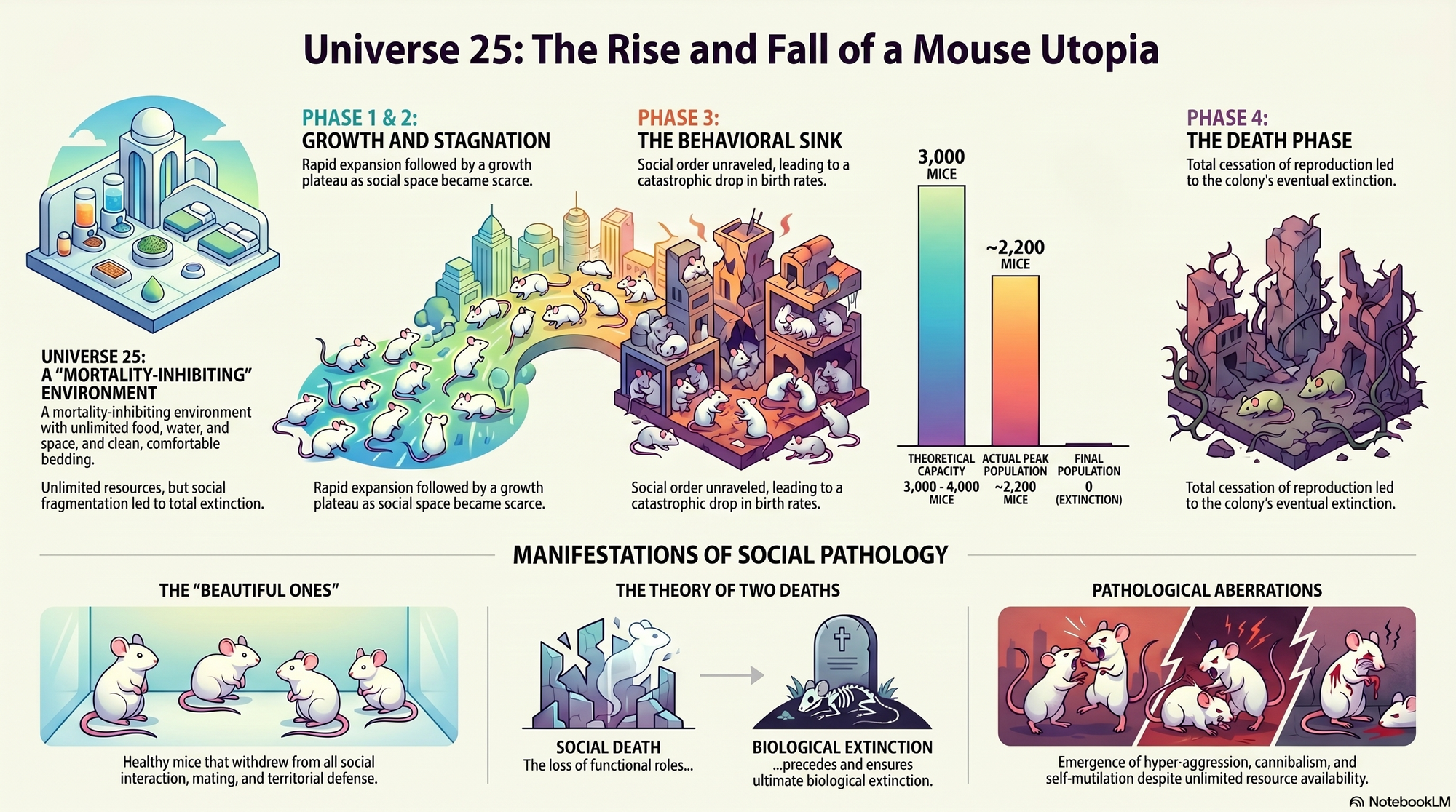
The physical architecture of Universe 25 was engineered to function as a closed, self-sustaining system, often colloquially referred to as a 'mouse utopia.' The enclosure occupied a footprint of approximately 10 feet by 10 feet, with a height of 1.5 feet [1][2]. This specific spatial configuration was critical; while it provided ample horizontal surface area for a growing population, the vertical limitation restricted the mice's ability to expand their environment, thereby forcing interaction and competition within a finite, fixed boundary [1].
The enclosure was constructed using durable, non-porous materials—primarily metal and glass—which were selected for their longevity and ease of sanitation [2]. The interior was meticulously subdivided into a series of interconnected compartments or 'rooms.' These compartments served distinct functional roles, including nesting areas, social gathering spaces, and feeding stations, all connected by a system of passages [1][3]. The design choice to utilize interconnected rooms was intentional: it allowed for the segregation of the population while simultaneously facilitating movement, which Calhoun hypothesized would lead to complex social stratification [1]. By controlling the size and number of access points between these compartments, the researchers could observe how the mice navigated the physical space as the population density increased. The primary objective of this structural design was to eliminate external mortality factors entirely, ensuring that any subsequent decline in the population could be attributed solely to internal social and behavioral dynamics rather than environmental failure [1][3].
1.2 Environmental Controls and Resource Provisioning
To maintain the integrity of the 'Mortality-Inhibiting Environment,' Calhoun implemented a rigorous system of environmental controls. The temperature within the habitat was strictly regulated between 20°C and 22°C (68-72°F), a range deemed optimal for the health and comfort of the mouse colony, thereby preventing stress-induced mortality related to thermal extremes [1][3]. Humidity levels were similarly managed to prevent the deleterious effects of excessive moisture or dryness, which could otherwise compromise the health of the subjects [1].
Ventilation was a critical component of the environmental control system. Given the high population density that the experiment was designed to accommodate, the accumulation of waste products—specifically ammonia from urine and fecal matter—posed a significant threat to long-term health. The ventilation system was designed to maintain air quality and ensure oxygen levels remained sufficient, even as the population reached its peak [3]. Lighting was provided to simulate a standard circadian rhythm, ensuring that the mice maintained normal biological cycles, while simultaneously providing the researchers with the necessary visibility for continuous, non-intrusive observation [1][3].
Resource provisioning was designed to be limitless. Food was provided in abundance via strategically placed bins throughout the enclosure, and water was supplied through an automated system that ensured constant, uninterrupted access [1][2]. Additionally, nesting materials such as cotton and shredded paper were provided in quantities that exceeded the needs of the population, effectively removing the competition for resources as a driver of natural selection [1][3]. By decoupling survival from the acquisition of basic necessities, Calhoun created a scenario where the only remaining stressors were social in nature. This 'utopian' provisioning was essential to the experiment's validity, as it allowed the researcher to test the hypothesis that population density, in the absence of external scarcity, would eventually lead to the breakdown of social order [3].
1.3 Data Collection and Observational Methods
The methodology employed by Calhoun was primarily descriptive and observational, focusing on the longitudinal tracking of the population’s trajectory. Data collection was multifaceted, combining quantitative metrics with qualitative behavioral analysis.
Quantitatively, the researchers maintained meticulous records of the population size, tracking birth rates, mortality rates, and the demographic composition of the colony over time [1]. These data points allowed for the construction of population growth curves, which were critical in identifying the inflection points where growth shifted from exponential expansion to plateau and, eventually, terminal decline [3].
Qualitatively, the observational methods were centered on the documentation of social behaviors. Researchers monitored the formation and dissolution of social hierarchies, the emergence of aberrant behaviors, and the breakdown of maternal and reproductive care. Because the experiment was designed to be a closed system, these observations were crucial for identifying the 'behavioral sink'—a term coined by Calhoun to describe the pathological social behaviors that emerged under conditions of extreme density [3].
It is important to note that Calhoun’s approach was not governed by pre-defined mathematical predictive models in the contemporary sense; rather, it was an inductive process where patterns were identified through the systematic observation of the colony's evolution [3]. The methodology relied on the assumption that the physical environment would remain constant, thereby isolating social density as the independent variable. The resulting data provided a detailed, if sobering, account of how a population responds when its physical needs are met but its social structures are overwhelmed by the pressures of overcrowding. This descriptive foundation remains the primary source for all subsequent analyses of Universe 25, serving as the basis for the theoretical interpretations that have defined the study's legacy [3].
2. Observed Social Dynamics and Behavioral Collapse
The Universe 25 experiment, a landmark in ethological research, meticulously documented the cascading effects of extreme population density on social structures and individual behavior within a controlled environment. John B. Calhoun's work revealed a stark progression from initial population growth to eventual societal collapse, driven not by a lack of material resources but by the overwhelming stress and breakdown of social order. This section delves into the observed population dynamics, the emergence and characteristics of the 'behavioral sink,' and the critical decline in reproductive success coupled with the rise of aberrant behaviors, all of which are central to understanding the experiment's profound implications.
2.1 Population Dynamics: Phases of Growth and Decline
Universe 25 was designed to allow for exponential population growth, with abundant food, water, and nesting materials, and the absence of predators or disease. However, the population's trajectory deviated significantly from a simple resource-limited carrying capacity model. Instead, social factors dictated the population's fate, leading to a series of distinct phases characterized by growth, stagnation, and ultimately, collapse [5].
Initially, the colony experienced a period of rapid population increase, termed 'Phase 1: The Young and the Beautiful.' During this phase, the environment was relatively uncrowded, and social structures, including mating rituals, territorial defense, and maternal care, were largely intact. Reproduction was successful, and the population expanded exponentially, mirroring typical colonization patterns in a new, resource-rich habitat [4].
As the population density increased, the growth rate began to slow, marking the transition into 'Phase 2: The Great Experiment.' This phase was characterized by increasing social interactions, which became more strained and competitive. While physical resources remained plentiful, the relative scarcity of social space and the intensification of social encounters began to exert pressure. The population continued to grow, but at a reduced rate, eventually reaching its peak during this period [5].
The population peak in Universe 25 was a critical juncture. While the environment could theoretically support a much larger population (estimated between 3000 and 4000 individuals), the colony's numbers plateaued and then began a sharp decline at approximately 2200 mice. This deviation from the carrying capacity underscored Calhoun's central thesis: that social organization, rather than material resources, could become the limiting factor for population growth [5].
Following the peak, the colony entered 'Phase 3: The Behavioral Sink.' This phase witnessed a dramatic and rapid decline in population size. The decline was driven by a catastrophic drop in birth rates and a simultaneous increase in mortality, particularly among the young and socially vulnerable. The social fabric had begun to unravel, leading to widespread behavioral pathologies that undermined the colony's ability to sustain itself [4, 5].
Finally, the experiment concluded with 'Phase 4: The Death Phase.' This stage was characterized by the complete collapse of social structures, the cessation of reproduction, and the eventual extinction of the population. The few surviving individuals were largely withdrawn, apathetic, and disengaged from any meaningful social interaction, existing in a state of profound social isolation within the crowded environment [4]. The quantitative evidence for this collapse is stark: the population failed to reach its environmental carrying capacity, peaking at a level where social disintegration became the dominant force, leading to a population crash rather than a stable equilibrium [5].
2.2 The 'Behavioral Sink': Emergence and Characteristics
The term 'behavioral sink,' coined by Calhoun, is central to understanding the pathological social dynamics observed in Universe 25. It describes the breakdown of normal social behaviors and the emergence of deviant, often destructive, patterns of interaction that occur in densely populated environments, even when material resources are abundant. The 'behavioral sink' is not merely a consequence of overcrowding but a complex phenomenon arising from the overwhelming social stress and the disintegration of social order [4, 5].
The emergence of the behavioral sink was marked by several interconnected pathological social interactions and the breakdown of established social roles. One of the most striking characteristics was the intensification of aggression. Males exhibited hyper-aggression, often engaging in unprovoked attacks on other males, females, and even young mice. These aggressive encounters frequently lacked clear social purpose, such as territorial defense or dominance establishment, becoming instead a pervasive and destructive element of social life [4, 5].
Simultaneously, there was a profound breakdown of social roles, particularly concerning reproduction and maternal care. Males failed to engage in courtship rituals or establish territories necessary for successful mating. Females, even when they managed to give birth, often exhibited a severe lack of maternal care. This included abandoning their young, attacking them, or failing to protect them from aggressive conspecifics. The breakdown of these fundamental roles directly contributed to the precipitous decline in reproductive success observed in later phases [4, 5].
Another hallmark of the behavioral sink was pervasive social withdrawal. While the environment was densely populated, many individuals retreated from social interaction. These mice often remained physically present but disengaged from all social activities, including mating, grooming, and defense. They appeared apathetic, lethargic, and often engaged in excessive grooming, sometimes to the point of self-harm. This withdrawal represented a coping mechanism for overwhelming social stress, leading to isolation even within the crowded conditions [4].
Calhoun's observations meticulously documented these phenomena. The 'behavioral sink' was characterized by a complex interplay of hyper-aggression, the failure of social roles, and widespread social withdrawal. These were not isolated incidents but pervasive patterns that defined the social environment of the later stages of the experiment. The term itself implies a downward spiral, a sink into social pathology from which recovery becomes increasingly unlikely as the social fabric disintegrates [4, 5]. The behavioral sink is thus a critical concept, illustrating how the quality of social interaction, rather than the quantity of resources, can determine the viability of a population.
2.3 Reproductive Decline and Aberrant Behaviors
The most devastating consequence of the social breakdown in Universe 25 was the catastrophic decline in reproductive success, inextricably linked to the emergence of a wide array of aberrant behaviors. These pathologies were not random occurrences but direct manifestations of extreme social stress, overcrowding, and the disintegration of normal behavioral repertoires [4, 5].
The decline in reproductive success was multifaceted. As noted, the breakdown of male courtship behaviors and female maternal care played a significant role. Males failed to perform the necessary rituals to attract females, and when mating did occur, the females often proved incapable of successfully raising offspring. Infant mortality rates soared due to neglect, abandonment, or direct infanticide by other mice. This failure was not due to a lack of nutritional resources for the young but a fundamental disruption of the social and behavioral mechanisms required for reproduction and nurturing [4]. Calhoun's research indicated that stress hormones, elevated by the intense social environment, likely impacted fertility and gestation, further contributing to the reproductive failure [5].
Concurrent with reproductive failure was the alarming rise of aberrant behaviors, which served as indicators of the profound psychological and social distress experienced by the mice. These behaviors represented a departure from the species' normal behavioral repertoire and were interpreted as maladaptive responses to the extreme conditions [4].
Key examples of these aberrant behaviors included:
- Cannibalism: Both males and females were observed to cannibalize their own young. This behavior, particularly disturbing in a species with otherwise strong maternal instincts, highlighted the breakdown of social bonds and the desperation or apathy that pervaded the colony.
- Self-Mutilation: Some individuals engaged in compulsive grooming that escalated to self-harm, such as biting off tails or ears. This was often associated with individuals exhibiting extreme social withdrawal and was indicative of severe psychological distress.
- Sexual Deviance: Beyond the failure of normal reproductive behaviors, there was an increase in non-reproductive sexual activities, including hypersexuality, homosexual behavior, and in some accounts, necrophilia. These behaviors further underscored the disorganization of social and reproductive drives [4, 5].
- Hyperactivity and Compulsive Behaviors: While some mice became withdrawn, others displayed hyperactivity and engaged in repetitive, compulsive actions, such as excessive grooming or pacing, further indicating a disordered state.
These aberrant behaviors were not merely curiosities but were deeply intertwined with the population's decline. They reflected a society that had lost its ability to regulate itself, where fundamental survival and reproductive instincts were overridden by the pressures of extreme social density. The quantitative evidence for this lies in the dramatic reduction of viable offspring and the high incidence of these pathological behaviors observed as the population dwindled. Calhoun's interpretation was that these behaviors represented a form of social suicide, a consequence of a population exceeding its capacity for social organization, even in the presence of ample material resources [4, 5]. The study of these behaviors is crucial for understanding the full scope of social collapse observed in Universe 25.
3. Theoretical Frameworks and Interpretations of Universe 25
The Universe 25 experiment, beyond its empirical observations of population dynamics, served as a fertile ground for theoretical conceptualization. John B. Calhoun developed and applied specific theoretical lenses to interpret the observed social breakdown and the ultimate fate of the mouse colony. Central to this interpretation are the concepts of the 'behavioral sink' and the 'theory of two deaths.' These frameworks, derived directly from the experimental data, offered Calhoun a way to explain not just the decline in population but the fundamental loss of social capacity and the subsequent extinction. Understanding these theoretical underpinnings is crucial for grasping the broader scientific and philosophical impact of the Universe 25 study, as they provided the explanatory power for the seemingly paradoxical collapse of a population in an environment of material abundance.
3.1 The 'Behavioral Sink' as a Theoretical Construct
The 'behavioral sink' is arguably the most enduring theoretical construct to emerge from Calhoun's work on Universe 25. Calhoun coined this term to describe the pathological social behaviors that emerged and intensified as a direct consequence of overcrowding within the experimental environment [7]. He conceptualized it not merely as a state of high population density, but as a dynamic process where the sheer volume of social interactions, necessitated by limited space, overwhelmed the mice's capacity for normal social functioning. This led to a breakdown in established social structures and the emergence of aberrant behaviors that ultimately undermined the colony's viability.
Calhoun observed that as the population density escalated, the frequency of social interactions increased exponentially. However, this increase was not accompanied by a commensurate rise in the quality or effectiveness of these interactions. Instead, the social environment became chaotic and dysfunctional. The 'sink' represented a feedback loop: the deterioration of social norms, such as territorial defense, nest building, and maternal care, created an increasingly stressful and unpredictable environment. This, in turn, further inhibited individuals from engaging in essential behaviors like reproduction, courtship, and child-rearing, thereby exacerbating the social breakdown [7].
The data types used to support this construct were primarily observational and descriptive, meticulously gathered through detailed ethograms and population statistics. Calhoun and his team did not rely on complex mathematical models in the traditional sense for defining the 'behavioral sink.' Instead, they focused on quantifying the frequency and nature of social interactions, categorizing them into normal, pathological, and withdrawn behaviors. Key metrics included the counts of aggressive encounters, instances of cannibalism, failures in mating rituals, and the proportion of mice exhibiting withdrawn or non-social behaviors. The 'sink' itself was identified by observing a qualitative decline in social order and the emergence of pathological interactions, even as the population density and the sheer number of interactions continued to rise. The environment became a 'sink' in the sense that it absorbed social interactions but failed to produce functional social outcomes, leading to a state of social collapse [9].
This theoretical construct posits that when the density of social interactions exceeds the capacity for meaningful individual engagement and social role fulfillment, a population will inevitably experience a breakdown in its social fabric. The 'behavioral sink' thus became Calhoun's explanation for why abundant resources (food, water, nesting materials) were insufficient to prevent population collapse; the critical limiting factor was the social environment itself, which had become toxic due to overcrowding.
3.2 The 'Theory of Two Deaths': A Teleological Interpretation
Complementing the 'behavioral sink' is Calhoun's 'theory of two deaths,' a conceptual framework that provides a teleological explanation for the ultimate extinction of the Universe 25 population. This theory posits that for a social species, survival is not solely defined by biological respiration but critically depends on the successful navigation and execution of complex social roles. Calhoun argued that a population could face not one, but two distinct forms of 'death,' with the first inevitably leading to the second.
The 'First Death,' as conceptualized by Calhoun, is the social or psychological death. This occurs when individuals within a population lose the capacity to engage in the complex social behaviors necessary for species survival and propagation. In Universe 25, this was most visibly represented by the group of mice Calhoun termed 'the beautiful ones.' These individuals were physically alive and healthy, spending their time eating, sleeping, and grooming themselves meticulously. However, they had completely withdrawn from social interaction, courtship, mating, and any form of parental care or territorial defense. They were, in essence, 'socially dead' because they no longer participated in the collective behaviors that sustained the colony's social structure and reproductive capacity [8]. Their existence was purely individual and devoid of social meaning or function.
The 'Second Death' is the biological death, the ultimate extinction of the population. Calhoun argued that the 'first death,' when it occurred on a widespread scale, made the 'second death' a mathematical certainty. Once a significant portion of the population became socially defunct, the ability to reproduce, raise young, and maintain the social order necessary for survival was irrevocably lost. Even if resources remained abundant, the population could no longer replace itself. The social 'memory' and the behavioral repertoire required for species continuity had been eroded to the point of no return [8]. The colony effectively became extinct long before the last individual organism died, as its social and reproductive capacity had ceased to exist.
Calhoun's 'theory of two deaths' integrated seamlessly with the 'behavioral sink.' The 'behavioral sink' described the process of social degradation driven by overcrowding. It was the mechanism that destroyed the social infrastructure of the colony. The 'first death' was the direct consequence of this sink; once the social environment became sufficiently pathological, individuals lost their capacity for complex social interaction. The 'theory of two deaths' then framed this loss of social capacity as the prelude to biological extinction. It shifted the focus of population dynamics from purely resource-driven Malthusian models to the concept of 'social capacity' – the ability of a species to maintain its social structure and behavioral complexity in the face of environmental pressures. This framework suggests that even in conditions of material abundance, a loss of social meaning and functional social interaction can lead to a population's doom, highlighting a philosophical dimension to population studies [8].
3.3 Scholarly Debate on Applicability to Human Social Dynamics
The profound implications of Universe 25, particularly its theoretical frameworks, have inevitably led to extensive scholarly debate regarding their applicability to human societies and urban planning. While Calhoun's work offers compelling metaphors and cautionary insights, the direct extrapolation of his findings to human civilization is fraught with significant challenges and criticisms.
Arguments for Applicability (with caveats):
Proponents of applying Calhoun's concepts to human societies often emphasize their metaphorical power. The 'behavioral sink' is frequently invoked as a potent illustration of the potential psychological and social consequences of extreme urban density, social isolation, and the breakdown of social cohesion. It highlights how environmental stressors, even in a controlled setting, can lead to an increase in pathological behaviors and a decline in community well-being. This has resonated in discussions about the psychological impact of overcrowded housing, the alienation experienced in large, anonymous cities, and the potential for societal anomie [9]. The 'theory of two deaths' also finds resonance with concerns about societal alienation and the loss of purpose or meaning, even in societies characterized by material prosperity. The experiment is often cited as a cautionary tale, suggesting that societies that fail to foster adequate social structures, opportunities for meaningful interaction, and a sense of collective purpose may face declines, albeit through more complex mechanisms than observed in mice [9].
Arguments Against Direct Applicability (Critiques):
However, a significant body of scholarly critique argues against the direct or simplistic application of Universe 25's findings to human societies. A primary criticism centers on the vast species-specific differences between mice and humans. Humans possess a level of cognitive complexity, cultural sophistication, abstract thought, problem-solving abilities, and capacity for intentional social organization and adaptation that rodents do not. Our responses to density are mediated by culture, technology, economics, and politics in ways that are fundamentally different from the instinct-driven behaviors of mice [9].
Furthermore, the methodological limitations of Universe 25 are frequently emphasized. The experiment was conducted in a highly artificial, closed environment with no external stimuli, escape routes, or capacity for environmental modification. It lacked the intricate socio-economic systems, political structures, cultural norms, technological innovation, and the ability to migrate or adapt environments that characterize human societies. Critics argue that the observed outcomes were a direct consequence of this specific, rigid experimental design rather than an inevitable trajectory for any high-density population [9].
The 'behavioral sink' and 'theory of two deaths' are also criticized for their oversimplification of social dynamics and their deterministic nature. They can be seen as overlooking the resilience, adaptability, and agency of human populations. Social scientists emphasize that human societies are not merely passive responders to environmental conditions but actively shape their social structures and behaviors in response to challenges. The experiment does not provide practical blueprints for designing human-habitable environments, as urban planning involves a far broader spectrum of considerations than simple population density [9].
Scholarly Consensus/Nuance: The prevailing scholarly view is that Universe 25 serves as a provocative, albeit flawed, thought experiment. Its primary value lies not in its predictive power for human societies or urban planning, but in its capacity to stimulate critical discussion about the potential negative consequences of extreme overcrowding, social isolation, and the breakdown of social norms. The concepts are best understood as cautionary metaphors that prompt reflection on the importance of social well-being and functional social structures, rather than as scientifically prescriptive laws applicable to human social dynamics [9]. The experiment's legacy is thus one of sparking debate and highlighting the complex interplay between environment, social behavior, and population viability, rather than offering definitive answers about human societal trajectories.
4. Critiques and Metaphorical Validity of Universe 25 for Human Civilizations
The profound and often unsettling observations from John B. Calhoun's Universe 25 experiment have, since its inception, invited extrapolation and comparison to human societal dynamics. While the experiment offers a stark, albeit simplified, depiction of potential consequences stemming from unchecked population growth and social disintegration, its validity as a direct metaphor for human civilization is fraught with significant limitations. This section critically assesses these limitations, focusing on the inherent risks of anthropomorphism, the methodological constraints of animal models, and the fundamental complexities of human societies. By dissecting these critiques, we can better understand Universe 25's enduring relevance as a cautionary tale rather than a predictive model.
4.1 Critiques of Anthropomorphism and Species-Specific Differences
A primary critique leveled against the interpretation of Universe 25's findings in the context of human societies is the pervasive risk of anthropomorphism – the attribution of human characteristics, emotions, and intentions to non-human animals. Extrapolating the behaviors observed in a population of mice directly to humans is inherently problematic due to the vast and fundamental differences in biological, cognitive, and social structures that separate these species. Mice, while social animals, operate on a fundamentally different level of complexity compared to humans. Their behavioral repertoire is largely driven by instinct, immediate environmental stimuli, and a more limited range of social learning. Human behavior, conversely, is profoundly shaped by abstract thought, complex cultural norms, historical consciousness, ideology, individual agency, and the capacity for self-reflection and deliberate societal change [10].
For instance, the 'behavioral sink' phenomenon, characterized by social withdrawal, increased aggression, and the breakdown of social roles observed in Universe 25, is a species-specific response to extreme population density and resource scarcity within a confined, artificial environment. While it might appear analogous to certain social pathologies in humans, such as increased crime rates or social fragmentation in overcrowded urban areas, the underlying mechanisms are vastly different. Human responses to similar pressures are not solely deterministic reactions to density; they are mediated by intricate social structures, economic systems, political institutions, and cultural values. The mice's inability to form complex social contracts, develop abstract solutions to resource management, or transmit sophisticated knowledge across generations means their 'collapse' is a qualitatively different event from any potential human societal decline [11].
Furthermore, the cognitive architecture of humans allows for a level of foresight, planning, and collective problem-solving that mice do not possess. Humans can develop technologies, create legal frameworks, establish educational systems, and engage in philosophical discourse to address societal challenges. The capacity for symbolic communication and abstract reasoning enables humans to adapt to changing circumstances in ways that go far beyond the instinctual or learned responses of mice. Therefore, viewing the mice's fate as a direct prefiguration of human destiny overlooks the unique evolutionary and cognitive trajectory of our species, which includes robust mechanisms for resilience, innovation, and self-correction that were entirely absent in the controlled environment of Universe 25 [11, 12]. The inherent biological imperatives of mice, such as their reproductive cycles and territorial behaviors, are also far simpler than the complex interplay of factors that influence human population dynamics and social organization.
4.2 Methodological Limitations and Environmental Artificiality
Beyond the issue of species differences, the experimental design and environmental conditions of Universe 25 present significant methodological limitations that constrain its applicability as a model for human societies. The creation of a 'Mortality-Inhibiting Environment' – a closed system providing abundant food, water, and protection from predators and disease – while intended to isolate the effects of population density, fundamentally altered the ecological and social pressures that shape natural populations and, by extension, human societies. This artificiality means that the observed outcomes are a product of a highly controlled, simplified system, rather than a reflection of the dynamic, complex interplay of factors present in the real world [11].
The absence of natural ecological pressures, such as predation, disease outbreaks (beyond those induced by overcrowding), resource competition in a dynamic environment, and the need for territorial defense against external threats, removed critical variables that drive adaptation and social organization in natural populations. Human societies, throughout history, have evolved under constant pressure from environmental challenges, resource fluctuations, and inter-group competition. These pressures have fostered innovation, cooperation, and the development of complex social structures and technologies aimed at survival and prosperity. Universe 25, by eliminating these pressures, created an environment where the only significant stressor was population density itself, leading to a potentially skewed and incomplete picture of societal dynamics [10].
Moreover, the definition of societal 'collapse' in Universe 25 was based on observable behavioral changes and population decline within the mouse colony. This metric, while quantifiable within the experiment, is a vastly oversimplified representation of human societal collapse. Human societies can experience decline, fragmentation, or transformation through a multitude of complex, interconnected processes, including political instability, economic crises, cultural shifts, technological disruption, and environmental degradation. These dimensions, with their intricate feedback loops and long-term consequences, are not captured by the simple metrics of population numbers and behavioral patterns observed in mice [11]. Calhoun's interpretation has also been criticized for potentially overemphasizing the deterministic nature of population density on behavior, while downplaying other contributing factors or alternative explanations for the observed phenomena. The experiment was conducted over a relatively short period in evolutionary terms, failing to capture the long-term resilience, adaptation, and cyclical dynamics that characterize human societal trajectories over millennia [10]. The simplified definition of 'social carrying capacity' in mice, based purely on behavioral breakdown, does not account for the human capacity to innovate and adapt resource management and social structures in response to perceived limits.
4.3 Universe 25 as a Cautionary Metaphor vs. Predictive Model
Despite its significant limitations, Universe 25 retains a potent, albeit controversial, relevance in contemporary discussions. Its enduring value lies not in its capacity to predict or precisely model human societal trajectories, but in its power as a cautionary metaphor. The experiment serves as a stark, visceral illustration of how unchecked growth, coupled with social fragmentation and a breakdown in social order, can lead to population decline and the erosion of complex behaviors necessary for societal continuity [11]. It prompts critical reflection on the potential consequences of overpopulation, resource depletion, and the psychological impacts of high-density living, urging societies to consider the non-material 'carrying capacities' related to social cohesion and psychological well-being [12].
The experiment's narrative of social withdrawal, escalating aggression, and reproductive failure resonates with anxieties about modern societal issues such as urban alienation, social isolation facilitated by technology, and the potential for social stratification to exacerbate stress and conflict. In this capacity, Universe 25 functions as a thought-provoking stimulus, encouraging dialogue about the importance of social infrastructure, community building, and the psychological health of populations. It highlights the idea that a society's ability to function and persist depends not only on material resources but also on the integrity of its social fabric and the well-being of its individuals [11, 12].
However, it is crucial to differentiate this metaphorical value from scientific predictive power. Universe 25 is not a predictive model for human societies. Human societies possess a far greater degree of complexity, adaptability, and agency than the mouse population in the experiment. Factors such as culture, technology, political systems, and individual consciousness allow humans to develop solutions, adapt to challenges, and alter their societal trajectories in ways that were impossible for the mice. The experiment's controlled, artificial environment and the species-specific nature of the observed behaviors make direct extrapolation to the multifaceted dynamics of human civilization scientifically unsound [10, 11]. Therefore, while Universe 25 can serve as a powerful, albeit flawed, metaphor to stimulate discussion and raise awareness about potential societal vulnerabilities, it should not be interpreted as a deterministic blueprint or a scientifically validated forecast of humanity's future. Its legacy is best understood as a cautionary tale, prompting vigilance and thoughtful consideration of the social and psychological dimensions of population dynamics and societal development, rather than a literal depiction of human destiny [12].
Conclusion and Enduring Legacy
This research has meticulously examined John B. Calhoun's Universe 25 experiment, dissecting its experimental design, the observed social and behavioral collapse, and the theoretical frameworks that emerged from it. The study began by detailing the creation of the 'Mortality-Inhibiting Environment,' a meticulously controlled habitat designed to isolate the effects of population density by eliminating external threats and resource scarcity. This foundational understanding of the methodology is crucial for appreciating the subsequent observations. The analysis then delved into the emergent social dynamics, charting the colony's trajectory from rapid growth through stagnation to a profound behavioral and reproductive collapse, famously characterized by the 'behavioral sink.' This phenomenon, marked by aggression, social withdrawal, and aberrant behaviors, underscored the detrimental impact of overcrowding on social organization. Finally, the theoretical underpinnings, particularly the 'behavioral sink' and the 'theory of two deaths,' were explored, revealing how Calhoun interpreted these observations as indicators of social species' vulnerability to population pressures. The 'behavioral sink' described the breakdown of social order, while the 'theory of two deaths' posited a social and biological extinction driven by the loss of functional social roles.
The value of Universe 25 lies not in its direct predictive power for human societies, but as a potent, albeit controversial, thought experiment. Theoretically, it advanced our understanding of population dynamics and the critical role of social behavior in population regulation, moving beyond purely resource-based models. Methodologically, it highlighted the power of controlled environments for isolating complex social variables, though it also exposed the limitations of such artificiality. Its practical value is primarily cautionary, serving as a stark reminder of the potential consequences of unchecked urbanization, social isolation, and the neglect of social structures. The experiment's enduring legacy is its ability to provoke critical discussions about societal sustainability and the psychological toll of dense, impersonal living environments.
Despite its influence, Universe 25 is not without significant limitations. The primary constraint lies in its extrapolation to human societies. The experiment's artificiality, the species-specific nature of rodent behavior, and the absence of human cultural, historical, and technological complexities render direct parallels problematic. The 'behavioral sink' and 'theory of two deaths' are powerful metaphors but do not represent deterministic laws for human civilization. Furthermore, the quantitative data, while charting population trends, often relies on qualitative descriptions of behavior, making precise statistical validation challenging without access to raw, granular data. The experiment's focus on density as the sole independent variable overlooks the intricate interplay of political, economic, and environmental factors that shape human societies.
Looking forward, the enduring questions raised by Universe 25 necessitate continued research into the complex interplay of density, social stress, and population dynamics, particularly in human contexts. Future research could benefit from interdisciplinary approaches, integrating sociological, psychological, and ecological perspectives to develop more nuanced models of societal resilience and vulnerability. Exploring the adaptive capacities of human societies, the role of technology in mitigating or exacerbating density-related issues, and the impact of cultural and institutional factors on social cohesion are critical avenues. The ultimate takeaway from Universe 25 is its capacity to stimulate critical reflection: it serves as a powerful, albeit imperfect, lens through which to examine the delicate balance between population growth, social organization, and the sustainability of complex societies, urging us to consider the qualitative aspects of social existence alongside quantitative measures of progress.
References
[1] llm_self_research
- Query: Detailed description of the physical setup, environmental conditions, and resource provisions within John B. Calhoun's Universe 25 experiment, focusing on the 'Mortality-Inhibiting Environment'.
- Summary: Universe 25, an experiment conducted by John B. Calhoun, was designed as a 'Mortality-Inhibiting Environment' to study the behavioral and social consequences of population density in a utopian setting for mice. The physical setup was an enclosed habitat, approximately 10 feet by 10 feet with a heigh...
[2] llm_self_research
- Query: Detailed specifications of the construction materials, dimensions, and specific environmental control mechanisms (e.g., exact temperature/humidity ranges, ventilation rates, lighting spectrum/intensity) used in John B. Calhoun's Universe 25 experiment, and any documented challenges or modifications to the environmental design during the experiment.
- Summary: Universe 25, an experimental environment designed by John B. Calhoun, was a 'Mortality-Inhibiting Environment' for mice, approximately 10 feet by 10 feet with a height of 1.5 feet. The construction materials are not explicitly detailed but are inferred to be durable, non-porous, and easily cleanable...
[3] llm_self_research
- Query: Detailed specifications of the environmental controls in Universe 25, including exact temperature ranges, humidity levels, ventilation rates, and lighting spectrum/intensity; any documented challenges or modifications made to the physical setup or environmental controls during the experiment; and any mathematical models or formulas used by Calhoun to predict or analyze population dynamics within Universe 25.
- Summary: Universe 25, an experimental environment for mice designed by John B. Calhoun, was engineered as a 'Mortality-Inhibiting Environment' to isolate the effects of population density on social behavior. The physical setup was an enclosed habitat, approximately 10 feet by 10 feet with a height of 1.5 fee...
[4] llm_self_research
- Query: Detailed observations of population dynamics and behavioral manifestations in the Universe 25 mouse experiment, including the 'behavioral sink', reproductive decline, social withdrawal, and aberrant behaviors.
- Summary: The Universe 25 experiment, conducted by John B. Calhoun, investigated the impact of population density and social stress on rodent behavior within a controlled environment designed as a 'mouse utopia' with abundant resources but limited space. The experiment observed distinct phases of population d...
[5] llm_self_research
- Query: Detailed quantitative data and statistical analysis of population growth rates, birth rates, mortality rates, and aggression levels in Universe 25. Specific examples of behavioral metrics used to define the 'behavioral sink' and its phases. Examination of any attempts to model these dynamics mathematically or computationally. Discussion of Calhoun's specific quantitative findings and their limitations.
- Summary: The Universe 25 experiment, conducted by John B. Calhoun, investigated population dynamics and behavioral pathologies in a controlled environment ('mouse utopia'). The experiment revealed a distinct pattern of population growth and collapse, characterized by four phases: rapid growth (Phase 1), stag...
[6] llm_self_research
- Query: Explore detailed statistical methodologies employed in analyzing Universe 25 data, and investigate subsequent research or reinterpretations that address the experiment's limitations or expand upon its findings regarding population dynamics and social stress.
- Summary: The Universe 25 experiment by John B. Calhoun employed descriptive statistics and behavioral categorization to analyze population dynamics and social stress in a controlled rodent environment. The primary statistical methodology involved meticulous observation and recording of population numbers, bi...
[7] llm_self_research
- Query: What are the core theoretical components of John B. Calhoun's Universe 25 experiment, specifically the 'behavioral sink' and the 'theory of two deaths', and how were these concepts derived from the observed population dynamics?
- Summary: Theoretical Frameworks of Universe 25
John B. Calhoun’s Universe 25 experiment (conducted in the late 1960s/early 1970s) served as a controlled environment to study the effects of high-density living on rodent populations. The resulting collapse of the colony was interpreted through two primary con...
[8] llm_self_research
- Query: What is John B. Calhoun's 'theory of two deaths' in the context of Universe 25, and how does it relate to the 'behavioral sink' to explain population collapse?
- Summary: The 'Theory of Two Deaths' and its Integration with the 'Behavioral Sink'
The Theory of Two Deaths: Conceptual Framework
Calhoun’s 'theory of two deaths' serves as a teleological explanation for the extinction of the Universe 25 population. It posits that for a social species, survival is defined by...
[9] llm_self_research
- Query: Analyze the mathematical and statistical methodologies John B. Calhoun used to quantify 'behavioral sink' and the 'theory of two deaths', and explore the scholarly debate regarding the validity of applying these rodent-based concepts to human social dynamics and urban planning.
- Summary: John B. Calhoun's Universe 25 experiment, conducted in the late 1960s/early 1970s, explored the effects of high-density living on rodent populations, leading to a colony collapse. Calhoun's work is interpreted through two primary conceptual frameworks: the 'behavioral sink' and the 'theory of two de...
[10] llm_self_research
- Query: Critiques of using Universe 25 as a metaphor for human societies and societal collapse, including limitations of animal models and complexities of human social systems
- Summary: The use of 'Universe 25,' John B. Calhoun's experiment with mice, as a metaphor for human societal collapse is subject to significant critiques, primarily stemming from anthropomorphism, methodological limitations of animal models, and the inherent complexities of human social systems. A core critiq...
[11] llm_self_research
- Query: Explore detailed analyses and specific examples of how John B. Calhoun's Universe 25 experiment has been applied or referenced in sociological studies, policy discussions, or public discourse concerning human societal dynamics, overpopulation, and collapse. Focus on identifying any quantitative data or modeling approaches used in these applications, and examine the documented relationships between the experiment's findings and broader sociological theories or models of societal change.
- Summary: John B. Calhoun's Universe 25 mouse experiment, while a potent metaphor for human societal collapse, faces significant critiques regarding its applicability to human societies. Core limitations stem from anthropomorphism, the risk of oversimplifying complex human interactions by directly mapping mou...
[12] llm_self_research
- Query: Explore specific historical or contemporary examples where Universe 25 has been explicitly cited as a model or cautionary tale for human societal issues, detailing the arguments made and the counter-arguments presented in those specific contexts. Also, investigate scholarly analyses that attempt to draw more nuanced parallels or distinctions between the behavioral sink in mice and specific human social phenomena like urbanization, social stratification, or technological alienation.
- Summary: Explicit Citations of Universe 25 as a Model/Cautionary Tale for Human Societal Issues:
Discussions on Overpopulation and Urbanization: Universe 25 is frequently invoked in popular science, environmentalist literature, and some social commentary as a stark warning against the potential consequence...